

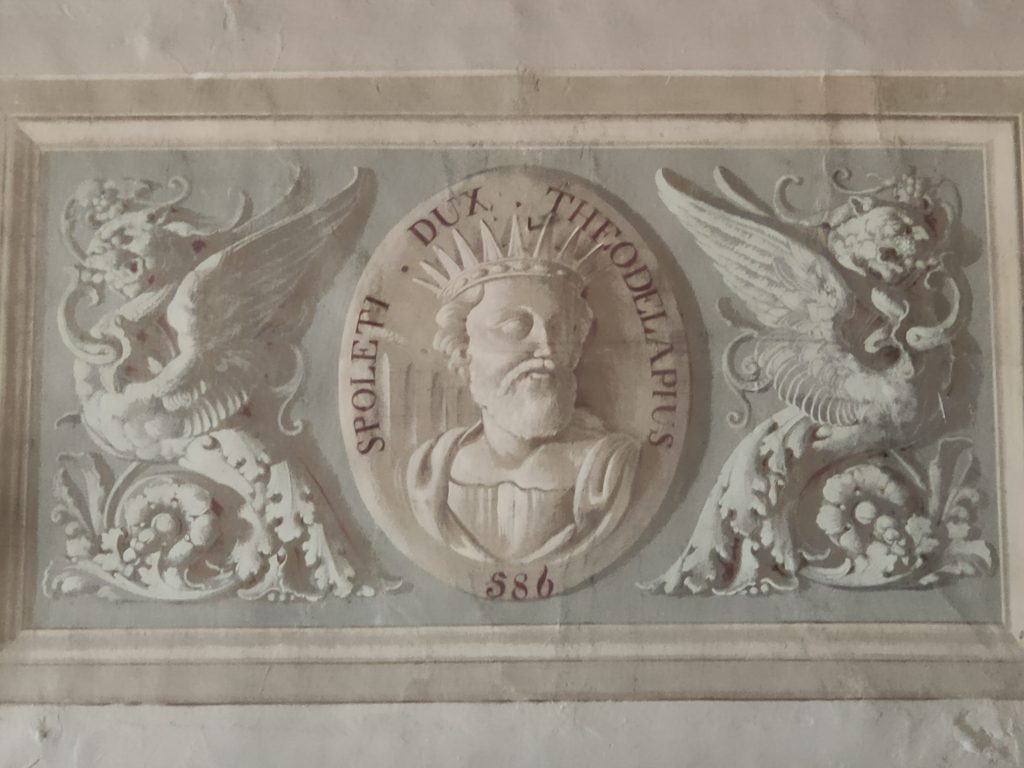
Theodelapius, duke of Spoleto
According to Spoletan historian Achille Sansi, “when duke Faroald died, he left two sons, who, because too young, were judged (as others rightly thought) by the leaders of the duchy to be unfit to govern, and had to give way to Ariulf.
Now, after ten years, when Ariulf had died, the two young men rose to contend for the dominion; and having found a following of partisans, they came to offence and bloodshed.
The dispute was finally decided in a battle, in which Theodelapius, who is not known whether he was the elder or the younger, was victorious, recognised duke of Spoleto and took over its government.
This is the first example of a war for the succession to the duchies, and it is another clear proof of the independent sovereignty of the dukes of Spoleto, especially if we consider that the king was not embarrassed by the dispute and then respected the elected.”
Theodelapius ruled the duchy for over half a century, until his death, sometime between 650 and 653. His reign appears to have been devoid of any significant events, even though he was able to enjoy a large degree of independence due to the weakening of the Langobards’ royal authority, which at that time was going through the so-called Period of the Dukes.
Certainly the duke of Spoleto, after the succession war, could not live for fifty years without drawing his sword, committed to maintaining the vast conquests made by his predecessor Ariulf, but the lack of sources prevents us from reaching conclusions about his rule.
Because of his long rule, he has been credited with the building of churches, palaces and other similar works typical of peaceful princes, of which Queen Theodolinda gave splendid examples at that time.
It is certain that the dukes built similar works, but the buildings they constructed in the city of Spoleto have either been completely lost or, in the remaining ones, it is not always possible to distinguish the Longobard phase from earlier or later periods.
In Spoleto, the capital of the duchy by the same name, a ducal palace was built, possibly by Theodelapius. It might have been built in the area formerly occupied by Theodoric’s palace, that now houses the archbishop’s curia.
Thanks to a Codex Farfensis we have a description of a vast, royal building that apparently stretched from the Forum to the Cathedral square; we will talk about this next time.
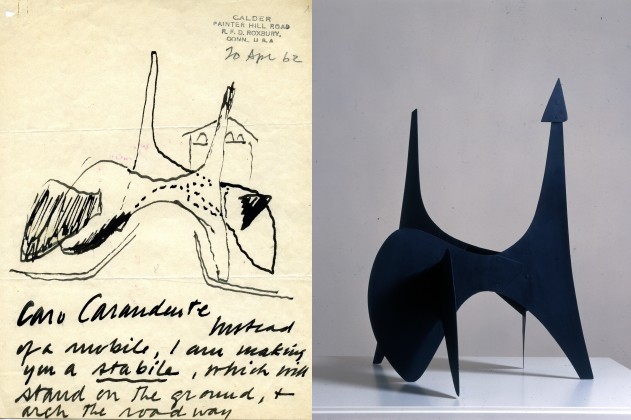
Inspired by the name of the Longobard duke, American sculptor Alexander Calder named one of his monumental steel works ‘Teodelapio‘, installed in Spoleto in 1962 for ‘Sculptures in the City’ and which he donated to the city.

“When confronted with images of Theodolapius, duke of Spoleto in the first half of the 7th century, wearing a crown with sharp points like his sculpture, without hesitation Calder said: ‘this is the name of the object'”. (Giovanni Carandente, Teodelapio, Alexander Calder, 1996).

The model of the work is on display in Palazzo Collicola, at the “G. Carandente” Modern Art Gallery, one of the most important spaces dedicated to contemporary art in Italy, while the actual sculpture welcomes travellers in front of the station and can be considered one of the symbols of the city of Spoleto.
Happy Monday at home with the Langobards!
NEWS ARCHIVES
- The duchies of Spoleto and Benevento | 3 August 2020
- Ariulf, 2nd duke of Spoleto | 27 July 2020
- The United Nations Educational, Scientific and Cultural Organization (UNESCO) | 20 July 2020
- The Langobards’ corner at Palazzo Mauri | 13 July 2020
- Mosaic at Palazzo Pianciani | 6 July 2020
- The Duchy of Spoleto: Palazzo Mauri | 29 June 2020
- Nine years ago, the inclusion into the World Heritage List (WHL) | 22 June 2020
- The two bishops | 15 June 2020
- The Duchy of Spoleto and it first dukeFaroald I | 8 June 2020
- Totemic animals in the Langobards’ imagery | 1 June 2020
- A thrust or a cut? | 25 May 2020
- The Warrior | 18 May 2020
- What a beard did these Langobards have!| 11 May 2020
- Intelligence in their hands| 4 May 2020
- The aurifex and the goldsmithing techniques in Langobard times| 27 April 2020
- The aurifex and the importance of goldsmithing in the Duchy of Spoleto | 20 April 2020


