

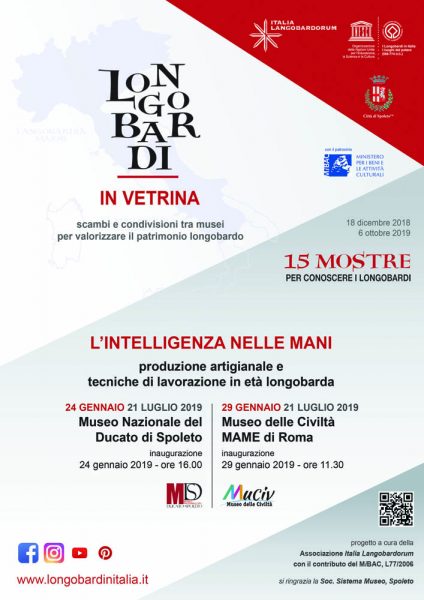
Manual Intelligence: Craft Production and Techniques in the Lombard Period
24 January – 21 July 2019
Museum of the Duchy of Spoleto | MuCiv – MAME of Rome
Openings
Thursday 24 January at 16 – Spoleto
Tuesday 29 January at 11.30 a.m. – Rome
15 exhibitions are held at the same time and 7 themes are treated within the project Longobards in the limelight. Exchanges and sharing between museums to enhance the Longobard heritage, conceived and coordinated by Italia Langobardorum Association, management structure of the UNESCO site “Longobards in Italy. The places of power (568-774 A.D.).
An ambitious project that enjoys the patronage of the Ministry of Heritage and Culture and obtained the contribution of MIBAC Law 77/2006, dedicated to Italian UNESCO sites.
The project aims at raising knowledge about Longobard culture through the enhancement of the museums located in the seven monumental complexes that are part of the UNESCO site, but also of those sites that were involved by the passage of the Longobards. Collaboration and synergy between museums are encouraged by temporary exchanges of artworks, divided into thematic exhibitions, hosted in the 6 museums of the UNESCO site network (National Archaeological Museum of Cividale del Friuli, antiquarium of Castelseprio, Museum of Santa Giulia in Brescia, National Museum of the Duchy of Spoleto, Diocesan Museum of Benevento, TECUM Museums of Monte Sant’Angelo) the Temple of Campello sul Clitunno, and eight other museums throughout Italy.
Exchanges between museums, temporary exhibitions and cultural support activities are also enhanced by an online virtual exhibition created with MOVIO (www.longobardinvetrina.it) and by a single catalogue, characterising this project as the first exhibition to be held nationwide, conceived as a set of exhibitions on Longobard culture; the largest exhibition in terms of territorial extension and involvement of institutions and historical-archaeological heritage.
Spoleto has focused on the theme of Manual Intelligence: Craft Production and Techniques in the Lombard Period.
Two exhibitions, promoted by the City of Spoleto, will be held at the Museum of the Duchy of Spoleto and at the MuCiv – MAME of Rome.
These exhibitions illustrate the technical-productive knowledge of the Lombards in Italy and identify the processes that led this people to integrate their technical heritage, typical of the Germanic population, with the Roman-Byzantine Mediterranean matrix, in a period of transition between the late ancient period and the early Middle Ages.
The Lombards had a particular “vocation for iron, steel and metallurgy” in line with the high technological level of production processes in the rest of the Germanic world, distinguishing themselves in the production of jewellery, weapons and tools.
To illustrate their craft skills, metal objects found in the necropolises of Nocera Umbra (PG) and Castel Trosino (AP) were selected. These objects were created with different techniques: mould casting, cloisonné, punching, filigree, damascening and niello.
Finally, there is also a brief reference to ceramic production, which shows its own clearly identifiable characteristics.
Opening ceremonies will be held on Thursday, January 24 at 16 in Spoleto and on January 29 at 11:30 in Rome.
Further information at www.longobardinitalia.it
