

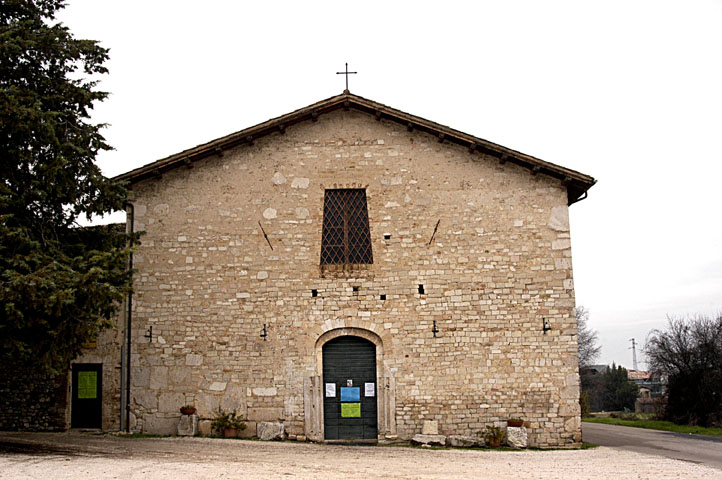
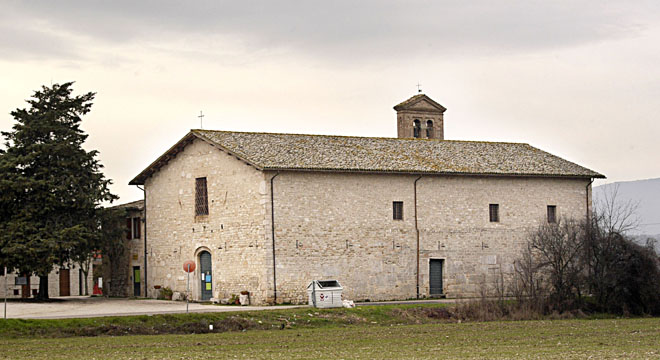

From Spoleto you take viale Marconi until Passo Parenzi; at the 1st roundabout you take the right and at the 2nd one you take the left, till you reach the church of San Sabino, dedicated to Spoletan bishop Sabino, martyrized around 310 and buried here. The Spoleto people held the saint in high consideration; a basilica was built on his burial place, using re-used material.
Bishop Sabino was arrested in Assisi and had his hands mutilated; a matron named Serena cured him and the grateful saint healed a niece of her who suffered from a serious eye-illness. When he was killed, Serena buried him on the spot where the basilica would eventually rise. Gregorius Magnus, Procopius from Cesarea and Paul the Deacon, they all mention him and his church. Paul the Deacon also speaks of the contacts between the Longobards and San Sabino, whom they also venerated. He was particularly prayed by those who were to leave for military campaigns, who habitually spent the night before leaving in his church; it is almost certain that San Francesco had here the dream that changed his life.
The church faced various transformations. The 1767 earthquake seriously damaged it and the restoration led to a change of the original structure. The present building shows a façade whose upper part is the fruit of an 18th century restoration; the apses, ruined by both men and time, still show the original aspect and impress for the big, re-used Roman blocks. The inside reveals a nave and side aisles, separated by alternate columns and pillars; a presbytery towers over a crypt, whose vault is sustained by re-used Roman columns; there lies the sarcophagus that used to keep the saint’s corpse. Some proto-Romanesque capitols are interesting.
Leaving the church behind, you get back to via Marconi, you pass through Pontebari and reach the small roundabout; taking the left you reach Morgnano, where you can visit the Mines’ Museum that, created on the structure of the Orlando Well (Pozzo Orlando – one of the accesses to the tunnels of the old brown coal mines), proposes objects, documents, films, excursions with the direct participation of former miners (to make the visit, please call 0743 22 57 00; e-mail: info@amicidelleminiere.it).
You then come back to the small roundabout in Pontebari and take the left: the diversions you meet on the right lead to the villages of Protte, Camporoppolo and Beroide, the latter provided for with a 14th century fortified castle. Close to the settlement, close to the via Flaminia, there is the little-known country church of Sant’Antonio abate; the inside, completely frescoed, presents a 15th-century cycle on the apse, dedicated to the popular saint, patron of animals and pilgrims (ask for the keys at the next manor house). After 4 Km about, you meet the village of San Brizio, a fortified settlement with an interesting Romanesque parish church, dedicated to the first Spoletan bishop.
LA BRUNA – CASTEL SAN GIOVANNI – CASTEL RITALDI – GIANO DELL’UMBRIA
Going on along the main road, you arrive at La Bruna , at the crossing of the area’s main roads. Here there is the Sanctuary of Madonna della Bruna, a Renaissance jewel built on the bank of the stream Tatarena, with a single nave and central plant, crowned by three apses. Over the major altar there is the painting of Madonna de La Bruna , thus called after the dark skin of Madonna’s face; the fresco is attributed to Tiberio Diotallevi from Assisi: From La Bruna you can reach Castel San Giovanni, a fortification whose construction started in 1376, with cylindrical and square corner towers. The ancient village is all inside the boundary walls that, along with the mighty corner towers, is the best preserved structure of the Spoleto flat. On the big, arched gate, there are two 16th-century coats-of-arms: the papal one and one with a Spoletan knight with the inscription SPOL DOM (under Spoleto rule). Until 1964, a big ditch surrounded the castle: On the gate, there are the evident traces of the ancient drawbridge.
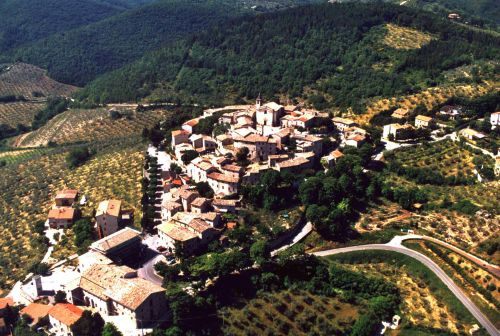
On a level above the local piazza, there is the church dedicated to San Giovanni Battista, re-built various times, with a beautiful 16th-century door and frescoes of Umbrian School. The most recent restoration followed the 1997 earthquake. From La Bruna, the road briefly climbs the slopes of Monti Martani and soon you reach Castel Ritaldi. Small hamlet raised probably as a Roman pagus, along the road from Spoleto to Montefalco. It is mostly surrounded by agricultural land with woods and charming hills with olive groves, vineyards and fruit trees. Picturesque roads climb through the hills where it is a pleasure to go walking, biking or horse-riding.

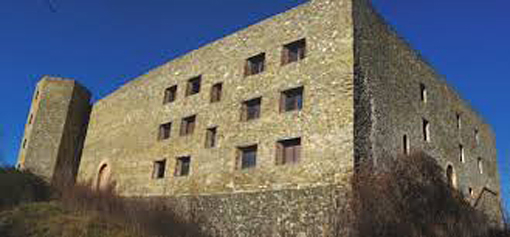
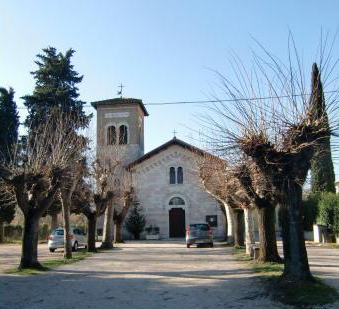
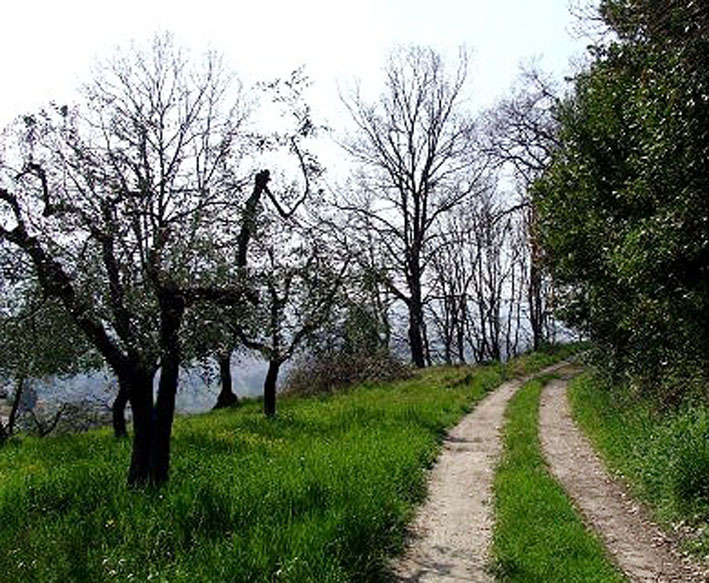
Beautiful sights on the villages and cities around scan the horizon, from Spoleto to Campello sul Clitunno, from Trevi to Foligno and Assisi. Castel Ritaldi got its name after the splendid castle owned by the Ritaldis. In the 11th century, a viscount used to reside here, administering a territory that included a number of castles, some of which still inhabited, other ones partly in ruin. Along with Colle del Marchese, the whole area was called “Normandia” and was a small, autonomous province within the States of the Church. The historical centre is surrounded by the walls of the 13th-century castle, where a visit to the Parish church of Santa Marina is a must; built between the 14th and the 15th centuries, it shows a Madonna with Child in a mandorla by Serafini (1508), a Madonna of Perpetual Help, attributed to Lattanzio di San Nicolò di Liberatore a.k.a. l’Alunno, and an interesting fresco by Tiberio d’Assisi. In the square, you see the Church of San Nicola, with a beautiful 1486 portal. Going out of the settlement in the direction of Colle del Marchese, you meet the Parish Church of San Gregorio in Nido, Romanesque building risen around 1141, with splendid bas-reliefs on the façade and on the portal by the embedded arches, with an archivolt showing vegetable motifs, intertwined with fantastic figures. In San Quirico, the original Roman find of the Lex Spoletina was discovered, an inscription on a stone that prohibited woodcutting in the Jupiter-dedicated sacred wood; it dates to the 3rd century and is on display at the Archaeological Museum.
You reach then Colle del Marchese, where the ancient, noble Spoletan family Parenzi owned wide pieces of land. There, you can see remarkable wall remains and the main bulwark turned into bell-tower. The castle, built in 1300, in the heart of the so-called “Normandia” has a circular plant and includes Middle Ages buildings. The Church of San Pancrazio shows a 15th-century pentagonal apse. On the wall at the back, a Praying Virgin, Crowned by Two Angels, a 16th-century fresco by Melanzio. On a wall outside there is a niche with a 15th-century marble bust of San Pancrazio. The Church of Madonna della Stelletta is nearby: inside, an 8th-9th century altar on a spindle-shaped stone and the church of Madonna della Selvetta.
You can go on then towards Macciano, and climb up to Giano dell’Umbria, on top of a hill at the height of 546 metres, closed on the south by Monte Martano (1094 metres). The name comes possibly from the presence of a Pagan temple dedicated to the god Giano. Surely the object of barbaric invasions, the settlement flourishes in the Middle Ages again, and extends its rule over the neighbouring villages.
From mid-13th century until the early 19th century, it remains under Spoleto, though with changing fortunes. In 1816, it becomes autonomous and remains such past the unification of Italy. The castle maintains its medieval shape.
Just outside the walls, there is the monumental complex of S. Francesco with its Church, dating to the second half of the 13th century. The outside, in pinkish ashlars and with a two-sloped covering, shows a façade, which is on an upper level than the original one.
The inside, rehandled in the 17th century, has six wooden altars in Baroque style, surmounted by remarkable canvases. The frescoes of the original Church were lately found behind some altars, adding to the precious 14th century paintings in the apse and to the important pictorial cycle attributed to painter Giovanni di Corraduccio from Foligno (14th century) in the crucifix’ chapel. Climbing up the castle’s alleys you reach the piazza del Municipio, with its Town Hall and the Church of Madonna delle Grazie, built in the 14th century and totally transformed in the 18th century. It keeps two remarkable canvases by Antonio Cavallucci (1794) and Andrea Polinori (1620), as well as remains of the 14th-century decoration above the major altar. On the very square, there is the 13th century Church of San Michele Arcangelo. Inside there are fragments of apse frescoes of 1501 and a 16th-century wooden crucifix.
The Abbey of San Felice, that can be reached through a panoramic route, is a Romanesque, Benedictine jewel, among the most interesting ones in central Italy. The church shows its original 12th-century, Romanesque structure. The façade in pinkish ashlars of San Terenziano, originally four-sloped, was widened and raised in the 16th century. Inside, there are a nave with side aisles, all barrel-vaulted, and an elevated presbytery. It keeps a 16th-century crucifixion. The crypt dates to the same period as the main body, and keeps a 4th-5th century sarcophagus with the relics of the Saint. The Romanesque style of the church, hidden by 18th-century interventions, was brought back to light by a 1958 restoration. The Augustinian cloister, built in the 17th century, has arches sustained by stout, four-cornered pillars.
Frescoes on the walls represent tales from the life of San Felice. The Abbey is the Spirituality Centre and Founding House of the Missionaries of the Very Precious Blood, who have been living in the coenobite since 1815. A bronze statue placed in front of the façade of the church, work by sculptor Franco Verroca, reminds of San Gaspare del Bufalo, founder of the religious order.
The network of small medieval hamlets that dot the territory of Giano, such as Montecchio, Castagnola and Morcicchia, is also a must-see. It was an actual fortified network to protect the Duchy of Spoleto, that still maintains today meaningful vestiges of its past.
Montecchio is an important castle towering over the ancient via Flaminia, already fortified in the 10th century. On its small piazza, there are the Palazzo della Comunità and the Church of San Bartolomeo, with fragments of frescoes of Umbrian School and an interesting 1430 antependium. Outside the settlement, there are the small Church of San Rocco and the remains of a building that has been serving as hospital since the 14th century. One km away, there are the remains of an imposing Roman villa under excavation.
In Castagnola, the castle maintains part of the walls and of its medieval layout. The ancient tower was turned into a bell-tower. The Church of S. Croce dates very likely to the 14th century. Not far away from the settlement there is the Sanctuary of Madonna del Fosco, by the 19th-century layout, built around a 15th-century votive chapel, frescoed by Ottaviano Nelli from Gubbio, in praise of an apparition of the Virgin.
Of the ancient castle in Morcicchia, only the public palace remains, a tank to collect rainwater and the meaningful remains of the boundary walls. Inside the hamlet there is the small 14th-century Church of S. Silvestro, heavily rehandled in the mid 20th century.
Not far away a mighty tower is visible, ancient remain of the Castle of Clarignano, already in ruin in the 14th century.