


Opposite Piazza Pietro Fontana, built on the site of a private vegetable garden and characterised by a fine 16th-century fountain and some Roman remains (partly visible inside the premises of the pharmacy), is Palazzo Mauri, an aristocratic residence dating from the 17th century and former seat of the prestigious Accademia Spoletina.
The noble Mauri family, owner of the palace, promoted its construction in the first half of the 17th century at the intersection of Via Brignone and Via dell’Arco di Druso, in a very important area of the city, facing Piazza del Mercato, the ancient Roman forum.
Completely renovated and restored (2009), the building has recovered the functionality of the rooms and the beautiful decorations of the reception halls, which are attributed to painters Alessandro Bottoni (17th century), Giuseppe Valeriani and Domenico Sergardi (18th century), well-known and active locally.
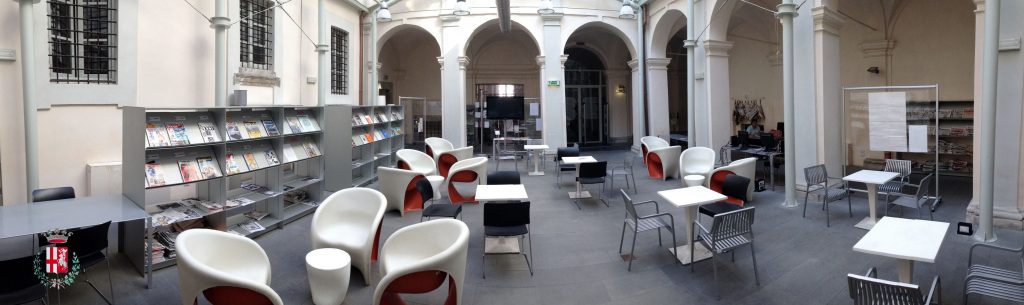
In the inner courtyard of the palace, protected by a transparent roof, a Literary Café has been created, with a newspaper and periodicals library and internet station, which is also used for concerts, meetings and readings.
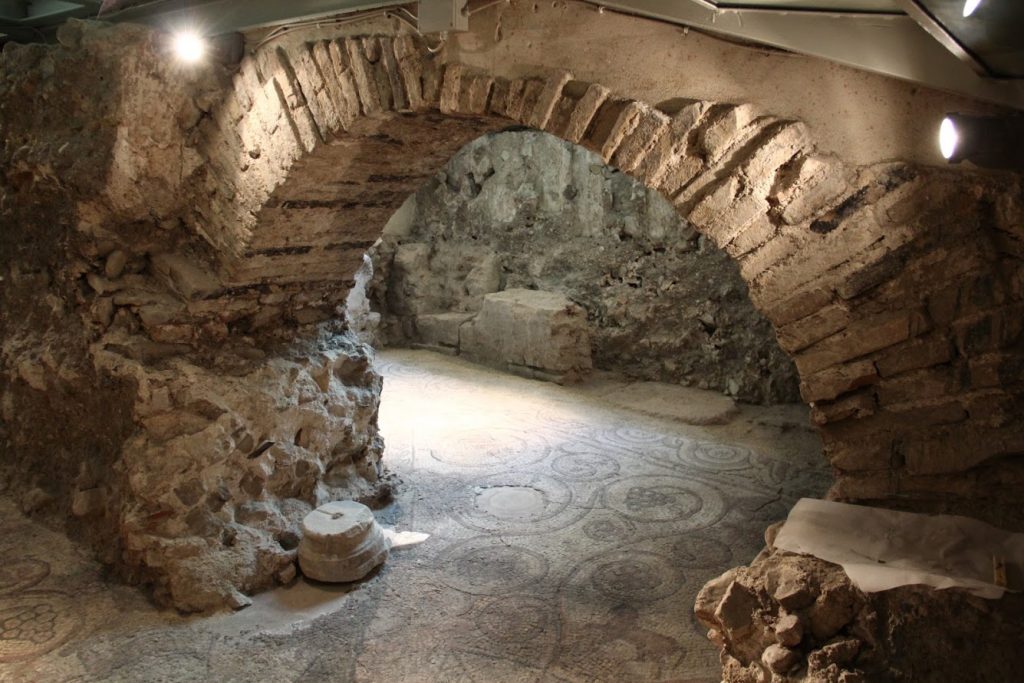
In the café there is an interesting 6th-century mosaic discovered during renovation work: the discovery has enriched our understanding of the complex urban stratification of the city, located near the area destined for the Forum in Roman times, which was transformed in the Lombard period.
The street encircling the palace is named after Fiordespina Lauri, a resolute Spoleto lady who did not hesitate to kill a dashing suitor who was pursuing her. The street, which leads through Vicolo delle Cantoncelle to the immediate vicinity of Viale Matteotti, offers a view of one of the city’s characteristic views, among ancient houses, arches and mighty walls supporting splendid hanging gardens. Among these is the so-called Piperno garden, where a section of the Roman walls can be seen with an inscription in capital letters bearing the names of the two personalities who oversaw its restoration in the first century B.C. (a cast of the inscription is on display in the hall below the arrival of the mechanised route that starts from the Spoletosfera underground car park).
Brief notes on Andrea Mauri
The construction and decoration of the palace in Spoleto was the work of Andrea Mauri, prefect general of the postal service and customs during the pontificates of Paul V and Urban VIII.
The Roman milieu that Mauri frequented, between the Borghese and Barberini families, greatly influenced his taste and artistic choices for his commissions in Spoleto, including the rich decoration of the chapel in the Spoleto Cathedral destined to house the ancient icon, traditionally donated by Barbarossa. In addition to considerable resources, he employed some of the artists in vogue in Rome: Gian Battista Mola, architect of the Chamber of Deputies, Cavalier d’Arpino and other still unidentified painters and sculptors of good standing.
The chapel was inaugurated in 1626, at a time when Mauri had also completed his ‘Roman style’ palace, perhaps by the same architect. By the time of Mauri’s death, the fresco decoration of the new palace was already complete, as is shown by the dates on the vault of the Sala degli Uccelli (1622) and, together with his signature, at the foot of the frescoes on the vault of Phaeton (1622) and the Sala della Giustizia (1625).
Thanks to his signature, we also know his name, Alessandro Bottoni da Parma, to whom the frescoes in the Sala degli Uccelli, dated but unsigned, and the vaults of two other rooms, the Sala di Saul and the Sala di Giuseppe, can also be attributed because of stylistic affinities.
Examination of the frescoed scenes reveals the client’s desire to decorate his home with images derived, almost to the point of copying, from models painted in the Borghese houses.
The portrait of Andrea Mauri in his mature years is sculpted in a marble bust, placed next to the icons, thus handing down his effigy.