

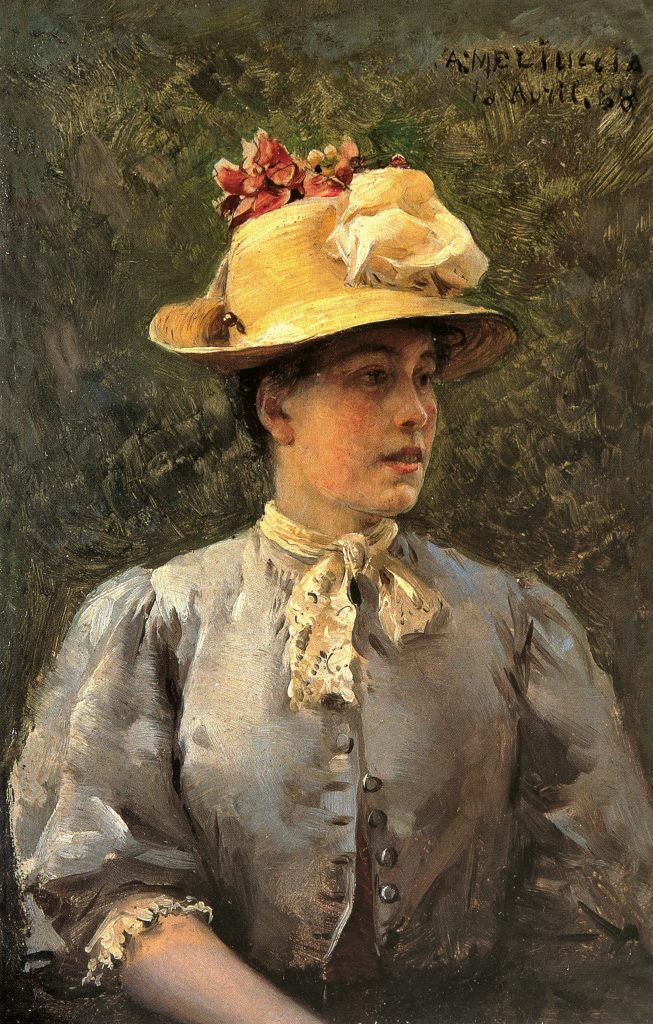
[High above: “Ameliuccia / 18 avril 88”]
Cesare Augusto Detti, brilliant painter and collectionist from Spoleto, was a protagonist of the artistic life in Paris during the belle époque.
He moved to Rome at the age of 15 to follow the lessons by Francesco Podesti and Francesco Coghetti at the Academy of San Luca, and by Mariano Fortuny who gave him a strong imprint to his art that would soon specialise in genre and costume painting.
While in Naples, he met the famous art merchant Adolphe Goupil who invited him to Paris, where he moved in 1870 and participated in many Salon editions, breaking into the hearts of the Parisian public. Encouraged by Goupil, he met Ignacio Leon y Escosura, with whom he shared a love of antiques and styles of the past.
Goupil greatly contributed to the reputation of the painter from Spoleto through the exhibition of his works in the famous gallery and the circulation in periodical publications such as the “Courier Français” and “Paris Illustré”.
While in Paris, Detti attends the elite of Italian painters living there, Boldini and De Nittis; with the latter in particular, he took part in the unique ‘Polenta Society‘, a sort of gastronomic circle created by Italian artists, of which the Spoleto native was indeed a promoter.
From Paris, he continued to send his works to the main Italian exhibitions, always remaining among the main exponents of Roman genre art.
The link with his hometown was kept alive thanks to his correspondence with the scholar Giuseppe Sordini and his membership of the Accademia Spoletina in 1894.
Alongside the production of frivolous and captivating genre scenes, there is a small production of portraits, dedicated to family members in which he achieves the best results, controlling the levity and the effects of idealising paintings destined for aristocratic and bourgeois collectors.
The Portrait of Emilie returns, as if it were a snapshot, the image of his young wife, who died prematurely, rendered with unusual freshness in the pictorial conduct and in the luminous effects, which reveal an approach, albeit superficial, to Impressionist painting, perhaps mediated through De Nittis.
The small portrait was donated to the Pinacoteca Comunale of Spoleto in 1937 by his daughter Anna and her husband Luigi Parmeggiani following a long negotiation that the City of Spoleto had begun with the painter’s heirs, which resulted in an exchange: Anna Detti offered four paintings in exchange for the portrait of his late sister Giuliette, donated in 1914 by the painter himself.
To learn more, please visit the “A tu per tu con l’arte” section of Palazzo Collicola here >> https://bit.ly/3cj6H9O
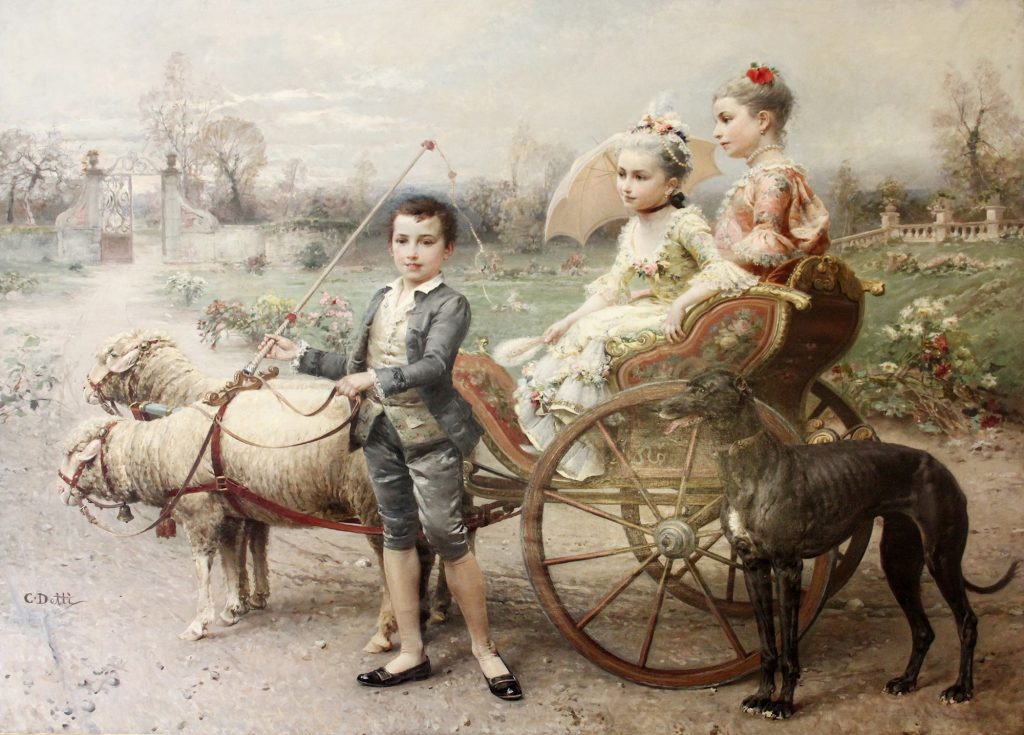
Bottom left: “C. Detti” | Spoleto, Palazzo Comunale
Well integrated in the artistic scene of late 19th century Paris, Detti had three children by marriage with the young Juliette Emilie Filieuse: Blanche Leontine (Anna), Cesare Italo Gonzalo and Giuliette.
Detti’s fame among the wealthy Parisian bourgeoisie and aristocracy enabled the family to lead a comfortable and quiet life in the villa of Marlotte near Fontainbleau, as documented by photographs and correspondence found in various archives.
The echoes of the successes he achieved in France reached Italy thanks to the circulation of his works in “L’illustrazione Italiana“, which earned him numerous honours.
Soon his fellow citizens also became aware of the painter’s fame: in 1892 the “Strenna Spoletina” published a reproduction of Ore felici (Happy Hours) and in 1894 his home town gave Detti a silver-gilt medal and a parchment illuminated by the painter Giuseppe Moscatelli.
A few years later, in 1896, after expressing his desire to leave a work of art to his home town on several occasions, Detti sent his fellow citizens this large painting of his three sons dressed in 18th-century clothing during a unique carriage ride in the garden of the family villa, accompanied by an elegant greyhound, as a sign of his gratitude.
A photograph in the Parmeggiani archive in Reggio Emilia is preparatory evidence of this graceful costume scene, kept in the Town Hall; in it, the painter’s three sons are immortalised in the same position as in the painting.
Compared to what the photograph shows, in the painting the physiognomies of the three children are, as usual, ennobled by the idealising imprint typical of Detti’s work.
The scene’s complacent coyness and the introduction of precious period costumes are in line with the widespread taste of the time, which brings this and other works by Detti closer to examples of 18th-century English and French painting.
To learn more, please visit the “A tu per tu con l’arte” section of Palazzo Collicola here >> https://bit.ly/3cj6H9O


