
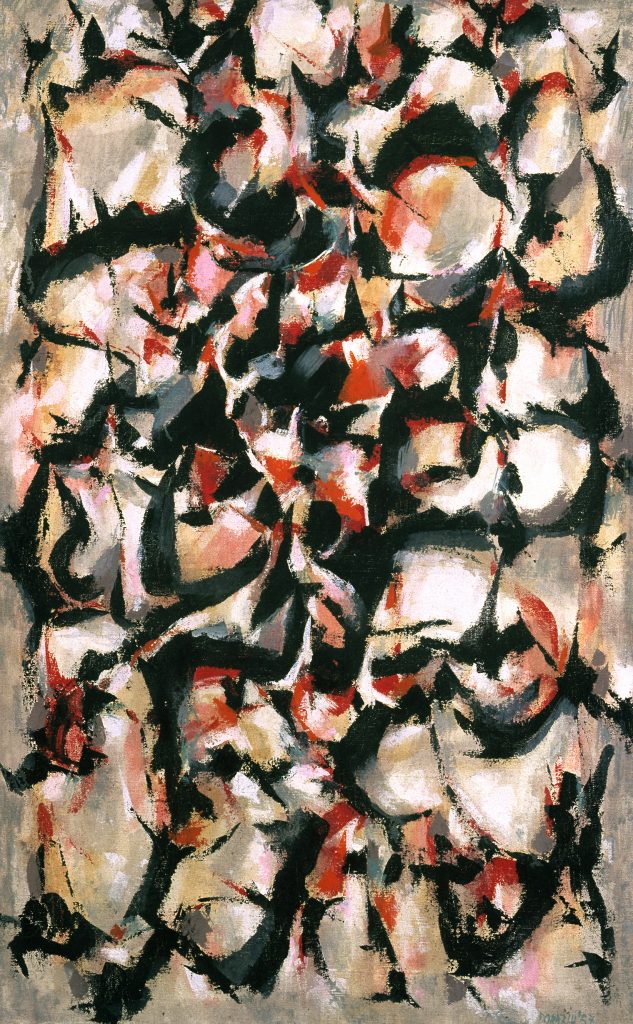
Piero Dorazio (Rome, 1927 – Perugia, 2005) – a pivotal figure in Italian abstractionism, after an initial militancy in the Arte Sociale collective, he was one of the signatories of the Forma 1 group manifesto in 1947.
Subsequently, together with Mino Guerrini and Achille Perilli, he opened the Age d’or gallery-bookshop, which soon became an important cultural crossroads. It was here, in fact, that he planned, in concert with Prampolini’s Art Club of which, in the meantime, Dorazio had become secretary, the important exhibition Abstract and Concrete Art in Italy which was held at the Galleria Nazionale d’Arte Moderna in Rome in February 1951.
To understand the international scope of Dorazio’s research, see his presence in the exhibition Monochrome Malerei, held in Leverkusen in March 1960 and presented by the critic Udo Kultermann, alongside, among many others, Fontana, Newman and Rothko, as well as in Nova Tendencija 1, organised the same year in Zagreb, together with the younger members of Azimuth, Group T and Group N, the French G. R. A. V. and the Germans Group Zero, and, in 1965, in the controversial The Responsive Eye at MoMA New York.
In the 1960s, Dorazio moves away from Informalism, to elaborate painting in a constructive direction through dense grids of chromatically differentiated bands, visibly created freehand to underline manual approach, in contrast to those who were trying their hand at an increasingly impersonal art.
He demonstrates an all-over conception of the canvas, interpreting the painting as a section of an uninterrupted continuum, a texture in which the stratifications of lines, although regularly executed, never appear mechanical, lacking the rigidity of a perfectly calculated alignment.
To learn more, please visit the “A tu per tu con l’arte” section of Palazzo Collicola here >> https://bit.ly/3cj6H9O
Vasco Bendini (Bologna, 1922 – Rome, 2015)
Winner of the Purchase Award at the first and fifth editions of the Premio Spoleto, in 1953 and 1957 respectively, he also exhibited in Spoleto on the occasion of the National Exhibition of Figurative Arts curated by Bruno Toscano at Palazzo Collicola, to then return in 1989 with a personal exhibition at the City Modern Art Gallery housed in Palazzo Rosari Spada.
Close to Informalist language in his youth, in the 1960s and 1970s he was sensitive to contaminations from the conceptual and poverist tendencies, before heading back to the shared return to painting of the late 1970s, to a register focused on sign and material.
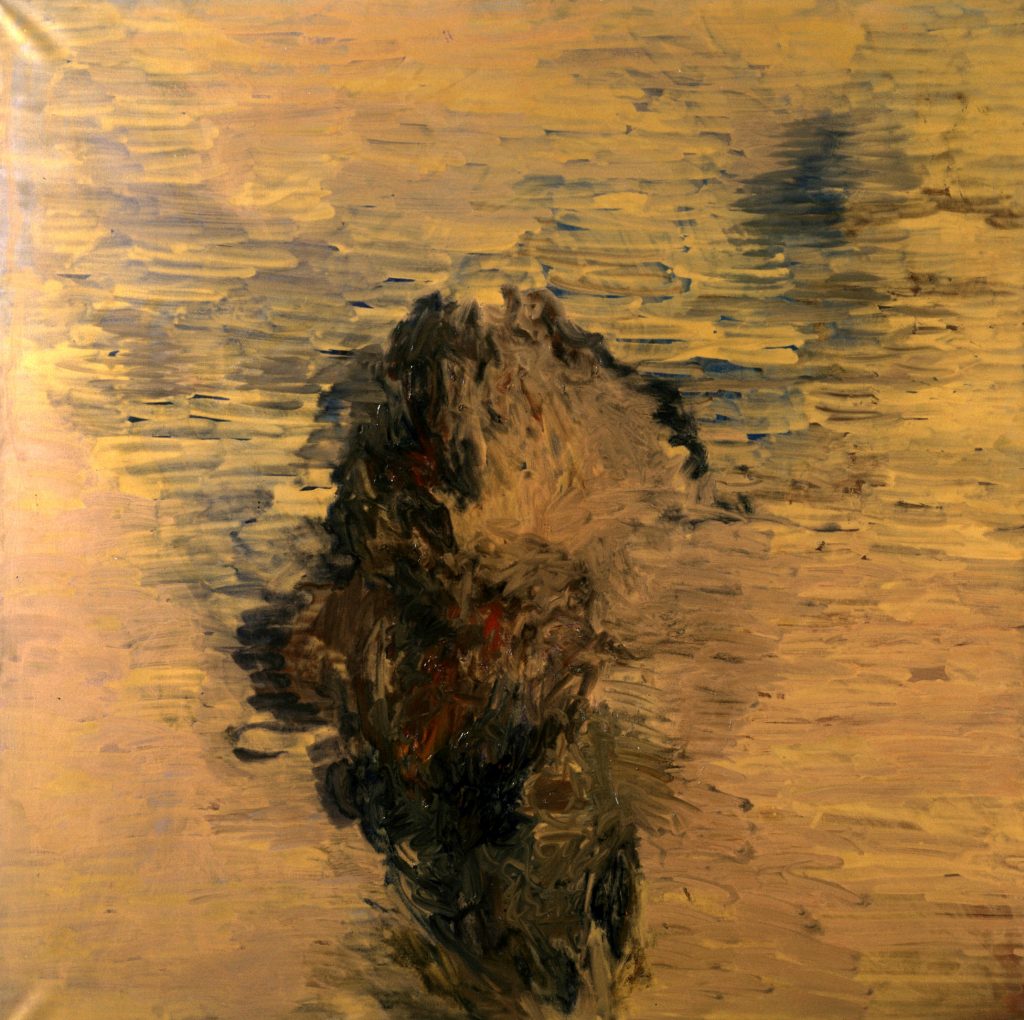
Dating from 1980, The Golden Hermitage in the collection of the “G. Carandente” Spoleto Modern Art Gallery belongs to this period. In the work, the brushstroke, like the propagation of a vibration, pervades the entire surface of the canvas, leaving visible traces of the living gestures of the artist’s hand.
Arranged as if to establish a luminous intermittence, the colour, similar to a breath, alternates moments of rarefaction with others of greater density as the tones change. In the depth generated by the overlapping of the chromatic stratifications, one glimpses an inscrutable light.
To learn more, please visit the “A tu per tu con l’arte” section of Palazzo Collicola here >> https://bit.ly/3cj6H9O


