

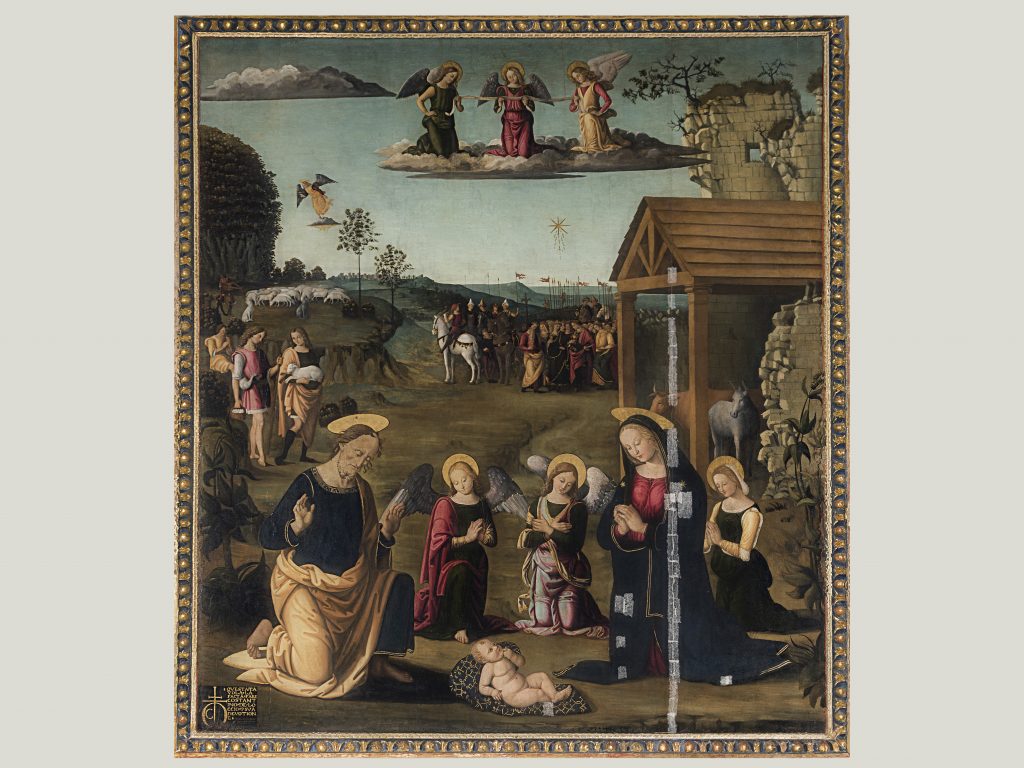
Giacomo di Giovannofrio was a Iucciaroni, a family of painters and carvers from Norcia, and worked actively in several churches in the Valnerina at the turn of the 15th and early 16th centuries.
The Adoration of the Magi is signed by the painter and also bears the name and trademark of the client, Costantino di Loccio, also from Norcia. The work was originally in the church of San Francesco in Norcia, where the Loccis used to have their family chapel; its presence in the church was still attested by the Spoleto bishop during a pastoral visit in 1817. A few years later, in 1823, it was removed and brought to the San Carlo orphanage, where other goods of the church had been brought following the supression of religious orders. In the inventory, the work is described as “a 10 X 7 foot painting representing the crib, by valuable painter, done in 1524 and come into possession of the San Carlo orphanage in the retrocession of the assets applied to the Convent of the Conventuals of Norcia to that bishop existing in that Church of the Conventuals, brought to Spoleto in 1823“. Like much of the artistic heritage owned by the orphanage, the work later found its way into the collections of the Pinacoteca Comunale of Spoleto, where Giovan Battista Cavalcaselle saw and drew it.
Giacomo di Giovannofrio’s culture is clearly linked to the painting of Giovanni di Pietro known as Lo Spagna. Except for a few small variations, the work is in fact completely inspired by his Adoration of the Magi, now in the Vatican Museums, and originally painted for Santa Maria della Spineta near Todi. In the centre is depicted the group of the Virgin with St. Joseph and the child with angels, while in the background we see the shepherds and the procession of the Magi arriving. The Adoration of Giovannofrio is important evidence of a local painting scene that looked with great interest at the achievements of Lo Spagna, in this case strengthened by the success the painter enjoyed in the context of Franciscan patronage.
To learn more, please visit the “A tu per tu con l’arte” section of Palazzo Collicola here >> https://bit.ly/3cj6H9O
St George and the Dragon, copy of Raphael
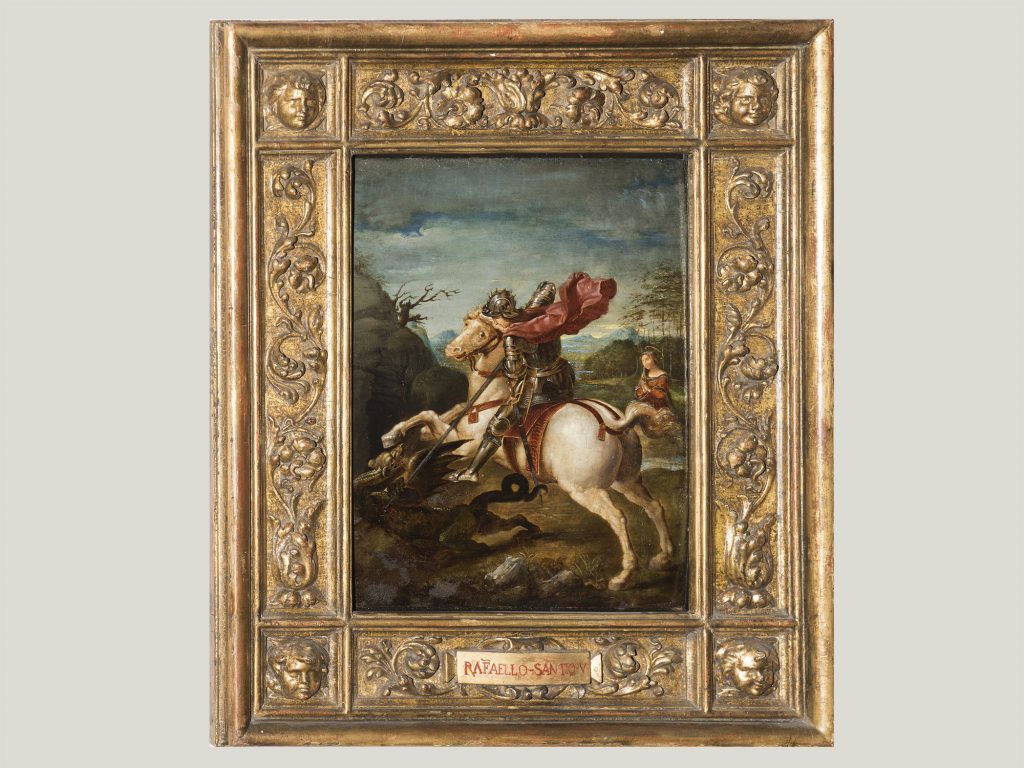
The painting is a copy of Saint George and the Dragon painted by Raphael around 1505 and kept at the National Gallery of Art in Washington. The work was commissioned by Guidobaldo da Montefeltro to be sent as a gift to Henry VII, or perhaps to his emissary, Gilbert Talbot, and arrived there through Baldassarre Castiglione.
The Spoletan copy in Spoleto, erroneously attributed to Raphael in the past, was donated to the Pinacoteca in 1954 by Anna Detti, daughter of the Spoletan painter Cesare Detti, and widow of the Reggio Emilia antiquarian Luigi Parmeggiani, who had worked mainly in Paris. The painting comes from this city, as evidenced by the Customs stamps and labels on the back, perhaps dating from before 1924, when the antique dealer closed his business. On the horse’s red breastplate is written RAPH, with a gap that must have contained the letters AEL, while on the back appears the number 50 in ink and another handwritten attribution “Raphael”. There is also a fragmented wax stamp with only the letters SUQ.
In the painting, Saint George is depicted according to his traditional iconography on horseback in his shining armour while piercing the dragon with his lance. On the right is the princess praying as she watches the hero in action and in the background is a delicate landscape with details of leafy trees. It is especially in the depiction of nature that some of the differences with Raphael’s original can be seen, particularly in the background and the plants growing on the rock on the left that houses the dragon’s cave. The carved and gilded frame, which confirms the attribution of the work to Raphael, is of great value.
To learn more, please visit the “A tu per tu con l’arte” section of Palazzo Collicola here >> https://bit.ly/3cj6H9O


