

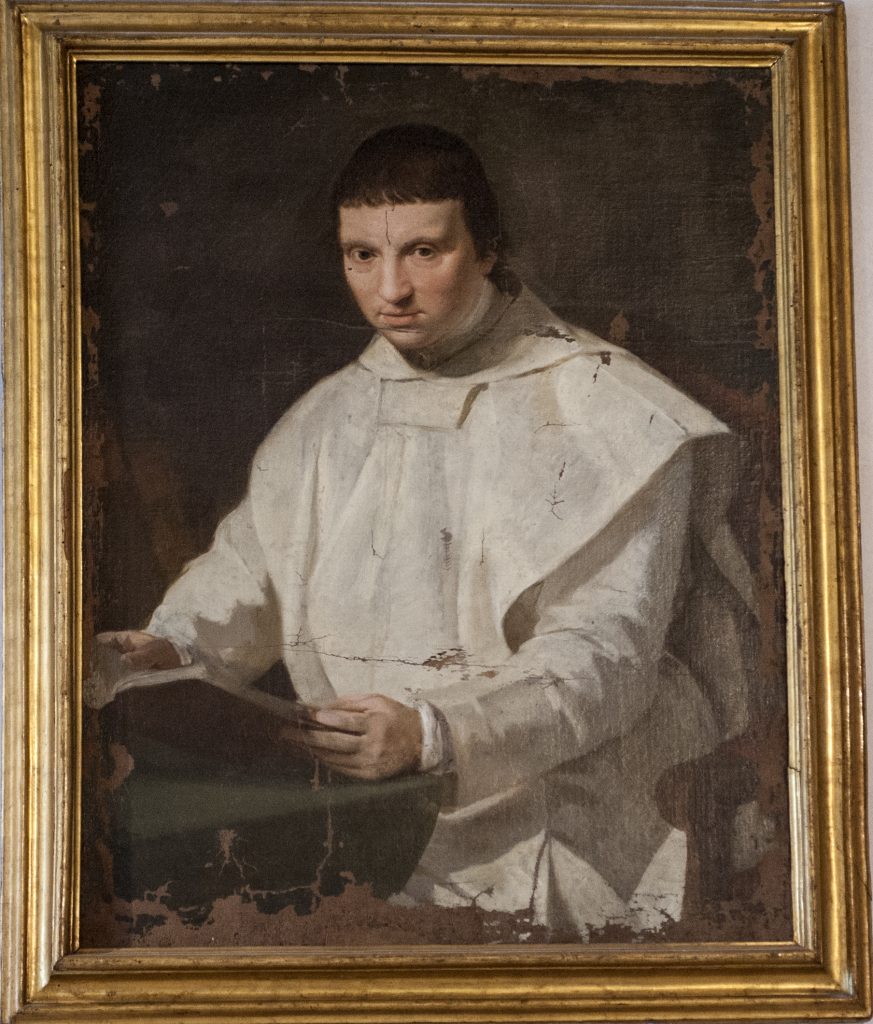
The portrait shows Stefano Ascanio Giannetti, born to a family from Lucca in 1757 and admitted into the Benedictine Olivetan congregation at the age of 16 yo. His brilliant carreer included the role of archivist of the Attorney General’s Office, the relations between the Olivetan Congregation and the Holy See, and his election as abbot general.
On the back of the original canvas, in an inscription considered to be late, the name of the monk depicted in the painting could be read as well as the place, the date of execution and the author, Francesco Manno, professor and Academic of St. Luke in Rome in 1798.
The canvas dates back to the period of Giannetti’s stay in Rome at the monastery of S. Francesca Romana and coincides with the activity carried out in the capital by the Palermo painter Francesco Manno, who arrived in Rome around 1786, where he was influenced by Pompeo Batoni‘s classicism.
Although it is part of the Roman culture of the end of the century, the painting is of a superior quality compared to the extensive sacred production by Manno, from which it differs for a greater rigor and sobriety and for the recovery of motifs of 17th-century classicism, while revealing an inclination of early “purist” taste.
The Olivetan Benedictine is portrayed here three-quarters in his monastic habit as he averts his gaze from the book in his hand and turns it towards the observer; his absorbed face and monastic habit emerge between the full light and the shaping shadows.
In the conspicuous documentation of the Sicilian painter’s pictorial activity there are no references to any portrait except the one depicting the painter Maria Maini and donated by the artist to the Academy of San Luca in 1822; the painting presented here is therefore almost the only known evidence of his activity as a portrait painter.
There is no documented information on the reason why the painting is included in the city collection. A plausible hypothesis is that of a family link between the monk and the dynasty of silversmiths by the same last name active in the city, but of Roman culture since the end of the 18th century.


