

June, 1929: an article in the Messaggero of the time, kept at the Carducci library, entitled: ‘Roman Relics in the Spoleto Gardens’.
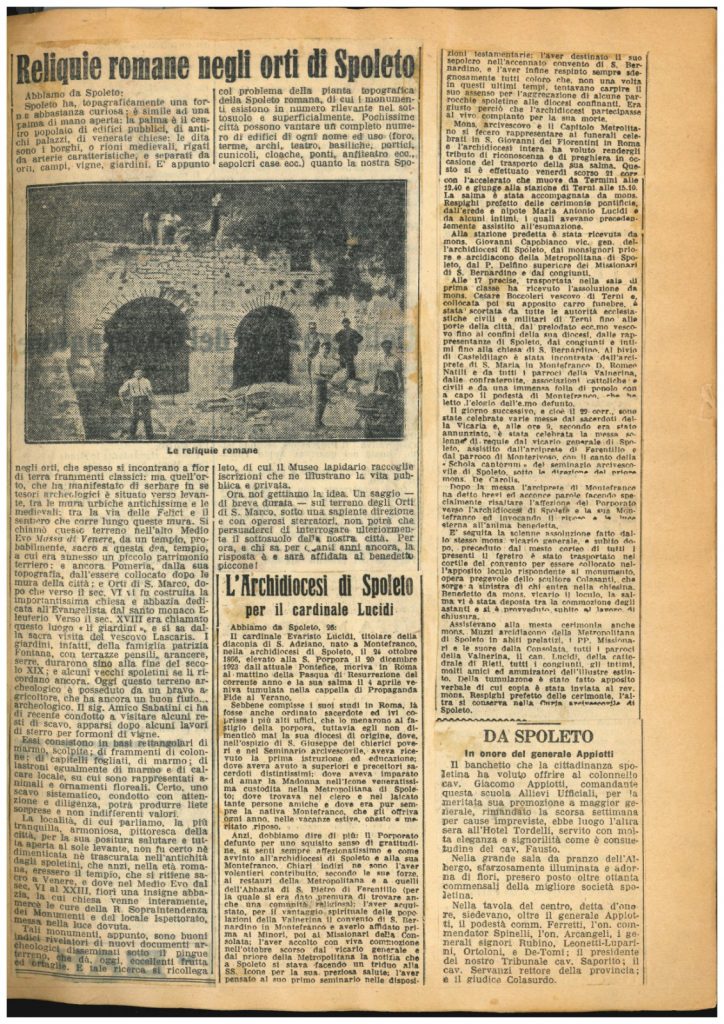
While carrying out earthworks, a farmer, owner of some land cultivated with vines in the area of Via delle Felici, came across numerous architectural remains and ended up finding a small treasure trove in his garden made up of ‘rectangular carved marble bases; fragments of columns, foliate marble capitals; slabs also of marble and local limestone, on which animals and floral ornaments are depicted’.
The area, fertile and fruitful for the produce of the land, is also fertile in terms of providing relics from the past, since it lies in a part of the city, immediately outside the ancient city walls and downstream from the church of San Simone, and is characterised by complex historical stratifications. And it was precisely in this plot of land, mentioned in ‘Il Messaggero’ in 1929, that archaeological excavations had been attempted for the umpteenth time some ten years earlier; these were promising because of the wealth of material found, but far from conclusive as they were not carried out in an organic, systematic manner.

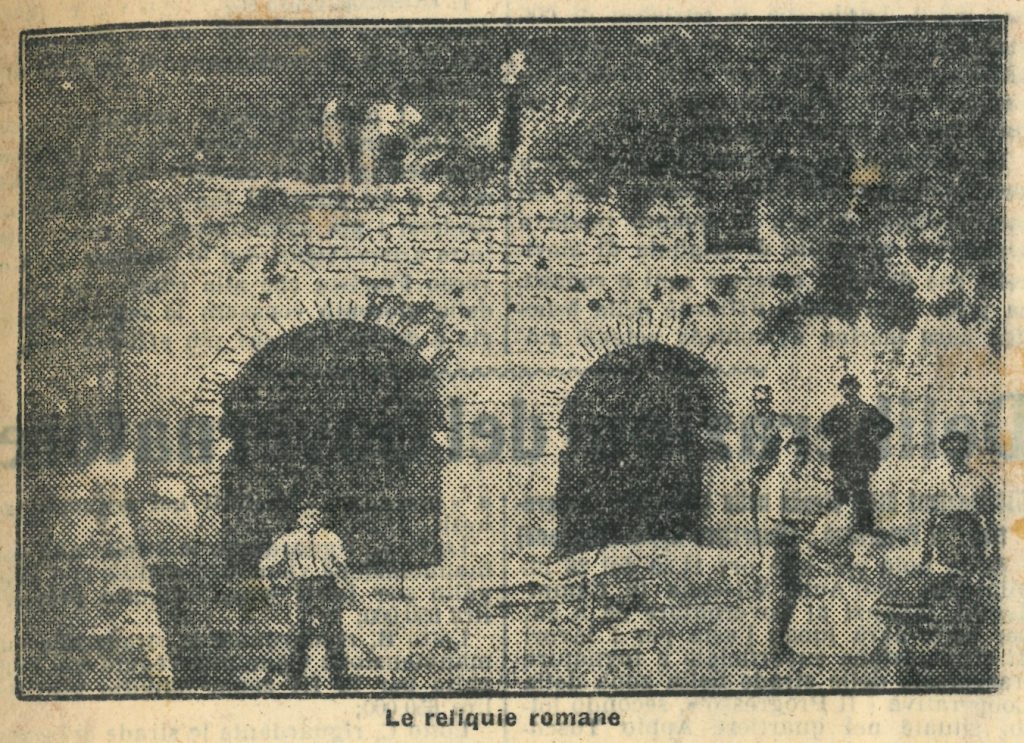
As can be clearly seen in the newspaper photo from 90 years ago, two round arches protrude from the ground of the terraced garden, probably the site of one of the oldest churches in Spoleto, a building that already existed in the 6th century, dedicated to St Mark and mentioned several times by Gregory the Great as a place of worship attached to the important monastery of St Mark the Evangelist in pomeriis, where Abbot Eleutherius lived. The church was in a bad condition in the first half of the 16th century, and at the end of the 18th century was battered by infiltration and buried up to the windows. It was demolished and replaced with a smaller church which still exists, also in a state of disrepair. Today, the two arches of the probable crypt of the 6th-century church are barely distinguishable, suffocated by the soil and vegetation.
From the second half of the 19th century, occasional excavation campaigns in the area of San Marco had brought to light various material dating back to the Roman period, in keeping with a long tradition, also cited in the article in the “Messaggero” and in contemporary guides to the city, attesting to the presence of a Roman sanctuary outside the walls dedicated to the goddess Venus, in particular Venus Felix, hence the name of Via delle Felici. A version that Achille Sansi in his “Storia di Spoleto” (History of Spoleto) treats with marked scepticism: “…it would be a vain effort to seek out to which deity it might have been dedicated; nor would I want to abuse the reader’s suffering, abandoning myself, where there is a lack of information, in the arms of imagination, the easy interpreter of all things. I will mention, however, that the name Via delle Felici or Via Felice, as it was also called, might arouse the thought that the street to which it led was the temple of Venus, which by ritual rule was usually placed outside the city. This is a conjecture, or rather a pure fantasy, which does however have a curious confirmation, and that is that the Church of St. Mark, which would have succeeded that temple, had a property called Massa di Venere”.
However, two things are unquestionable: one, as we said at the beginning, is the stratigraphic richness of an area that has left precious evidence from various periods. Just think of the floor mosaic, datable to the period of foundation of the monastery, i.e. the 6th century, made of polychrome marble and stone, which is now preserved in the Museum of the Duchy at the Rocca Albornoz.
The other certain fact is the need to safeguard and recover an area that represents a very important element of the artistic history of the city, on which stands a monument of the early Christianity. Despite the fact that it was written almost a hundred years ago, the closing idea and wish in the “Messaggero” are still highly topical, given the condition of the remains: “A short trial on the land of the gardens of St Mark, under expert direction and with hard-working excavators, can only persuade us to further investigate the subsoil of our city. For now, and who knows for how many more years, the answer is and will be entrusted to the blessed pickaxe!”.
NEWS ARCHIVES
- Olive oil exhibition in 1930 | 18 December 2020
- The Town Hall in 1913 | 4 December 2020
- 1865: The third leg of the works on the Traversa Interna begins | 27 November 2020
- The birth of the Cotton Mill | 20 November 2020
- Racewalkers at the Giro della Rocca prepare themselves for the London Olympic Games: June, 1948 | 13 November 2020
- Teatro Nuovo: 10-11 September 1864 | 6 November 2020
- Images, August 1948. Teatro Nuovo, Spoleto, second edition of the competition for young opera singers | 30 October 2020
- The 1948 Mille Miglia in Spoleto. That time when Tazio Nuvolari… | 16 October 2020
- Beniamino Gigli in Spoleto in September, 1932 and August,1939 | 9 October 2020
- The Casina dell’Ippocastano | 2 October 2020
- Catalogue of public posters as documents of city chronicles | 25 September 2020
- 27 May 1948. When Gino Bartali crossed the finish line in Spoleto | 18 September 2020
- The Festival Of Two Worlds’ Yearbooks from 1975 to 1979 | 11 September 2020
- The 1967 Festival Of Two Worlds’ Yearbook | 26 August 2020
- The Festival Of Two Worlds’ Yearbooks #2 | 21August 2020
- The Festival Of Two Worlds’ Yearbooks | 19 August 2020
- 1947-48: Motorcycling in Spoleto | 14 August 2020
- When the Spoleto soccer team’s name was Virtus | 7 August 2020
- Ads and commercials in 1910 Spoleto | 24 July 2020
- The Spoleto City Museum | 17 July 2020
- Restoration works at the Teatro Caio Melisso | 10 July 2020
- Folk feasts’ posters in early XXth-century Spoleto | 3 July 2020
- “Urban VIII on his way to Rome”: or the odd story of the Spoletan Bernini | 26 June 2020
- The ex Spoleto-Norcia Railway: from the first project to its opening | 19 June 2020
- Spoleto Tourist Guidebooks #3 | 12 June 2020
- Christo’s Art at the Festival of Two Worlds | 5 June 2020
- Raffaele Canè – Pictures | 29 May 2020
- Spoleto Tourist Guidebooks #2 | 22 May 2020
- Spoleto Tourist Guidebooks | 15 May 2020
- Pietro Mascagni: the concert at the Teatro Nuovo | 8 May 2020
- The cable car Spoleto-Monteluco | 1 May 2020
- Two days of aviation in Spoleto | 24 April 2020


