

Sorry, this entry is only available in Italiano.
Open to the public from 4 July (15.30) to 13 September 2020
Appartamento Nobile, Palazzo Collicola – Spoleto
Project realised thanks to the Exhibit Program | Directorate General for Contemporary Creativity of the Ministry of Cultural Heritage and Activities and Tourism
Opening hours:
October: from Thursday to Monday 10.00-13.00 / 15.30-19.00
Although all of Paolo Canevari‘s work can naturally be said to be “in black” and has always been conveying obscure contents, no one would ever think to relate it to disturbing facts of our existence exactly when we experience them. But art has a role in history, especially when it tells us something profound about the times we live in, like them or not; in this sense Canevari’s work is as relevant as ever.
The black hole of the pandemic that has shaken the world’s economy, affections, social relations, vision of public and private life, is in some ways an integral part of the tragic and recurring stories that characterize our global era: Canevari’s work lies exactly in this flow.

An articulated exhibition at Palazzo Collicola, in a path that winds from outside the museum with a real symbol (a sculpture unpublished and specially made for the occasion) of the freedoms suspended during months of lockdown around the world and of the many losses that have made the US the nation with the highest number of victims (100.000 at the time of writing): the Freedom of the Monuments of Memory cycle (the statue that illuminates the world, better known as the Statue of Liberty) landed on the external base of the sculpture in Piazza Collicola. While waiting to get up again in a definitive way, the work presents itself as a monument not to forget, to remember and to overcome a collective mourning and an evil that is not yet defeated.
A sign that contemporary art can and must at times confront us with the hardest and most tragic reality, communicating the violence of our times without rhetoric, without false embellishments, even at the cost of posing as an anxious, perturbing object.

Materia oscura (Dark Matter) unwinds then inside the Piano Nobile of Palazzo Collicola, following a path that sees the exhibition of more recent works (sculptures and drawings) from the Monumenti della memoria cycle created between 2016 and 2020 (Vasi, Altare, Tappeto, Landscape), historical sculptures such as Lupe Romane, ThANKS, Colossei and J.M.B. and a selection of video works from the 2000s inspired by the theme of fire such as Burning Skull, Burning Gun, Burning Colosseum, Burning Mein Kampf.
In the contrast between the magnificence of the Appartamento Nobile, the 18th century residence of the Collicola family, rich in antique paintings, gilded frames, frescoes and precious marbles, and Canevari’s “dirty”, cathartic work, a mechanism of alarm, emergency, surprise is intentionally set in motion, keeping the conscience of history awake, in a continuous, interrupted flow back and forth between past, present and future.
Paolo Canevari (Rome, 1963). After graduating from the Academy of Fine Arts in Rome, in 1999 he participated in the XIII Quadriennale in Rome and in 2000 he had solo exhibitions in Rome at the Stefania Miscetti Gallery and the Center for Academic Resources in Bangkok. In 2001 he held solo exhibitions in Siena at the Palazzo delle Papesse and many others between 2002 and 2019 at the Christian Stein Gallery in Milan. In 2004 he held the solo show Welcome to OZ at P.S.1 in New York curated by Alanna Heiss, in 2006 A Couple of Things I Have to Tell You at the Sean Kelly Gallery in New York and presented the work Rubber Car at MART in Trento and Rovereto as part of the exhibition Mitomacchina, and also participated in the Peace Tower project at the Whitney Museum of American Art Biennale in New York.
In 2007 he exhibited at MACRO in Rome with the solo show Paolo Canevari – Nothing from Nothing, and participated in the LII Venice Biennale curated by Robert Storr with the video Bouncing Skull, which will become part of the permanent collection of the MoMA in New York. In 2008 he held the solo show Decalogo at the Istituto Centrale per la grafica-Calcografia Nazionale in Rome, while in 2010 he held the solo show Paolo Canevari – Nobody Knows at the Pecci Museum in Prato, curated by Germano Celant and the solo show Odi et Amo at the Galleria Nazionale d’Arte Moderna in Rome. In 2011 the solo show Decalogue at the historic institution The Drawing Center in New York is curated by Brett Littman and in 2015 it is included in Arts&Foods. Rituals since 1851, curated by Celant at the Triennale di Milano, as part of the events of Expo Milano.
In 2015 the permanent work Souvenir is presented at the Olnick Spanu Art Program space in Garrison (New York) and in 2018 he is invited to the first Bangkok Biennale. His drawings from the 1990s series Memoria Mia are published in the book of short stories I tacchini non ringraziano by Andrea Camilleri. In 2020 he participated in the following exhibitions: Selfportrait of the artist as a clown at the Gallery Antwerp & Knokke, La Rivoluzione Siamo Noi Collezionismo italiano contemporaneo and Urban Landscapes Human Code at Dip Contemporary Art in Lugano.
Sorry, this entry is only available in Italiano.
Open to the public from 4 July (15.30) to 13 September 2020
Appartamento Nobile, Palazzo Collicola – Spoleto
Project realised thanks to the Exhibit Program | Directorate General for Contemporary Creativity of the Ministry of Cultural Heritage and Activities and Tourism
Opening hours:
October: from Thursday to Monday 10.00-13.00 / 15.30-19.00
Although all of Paolo Canevari‘s work can naturally be said to be “in black” and has always been conveying obscure contents, no one would ever think to relate it to disturbing facts of our existence exactly when we experience them. But art has a role in history, especially when it tells us something profound about the times we live in, like them or not; in this sense Canevari’s work is as relevant as ever.
The black hole of the pandemic that has shaken the world’s economy, affections, social relations, vision of public and private life, is in some ways an integral part of the tragic and recurring stories that characterize our global era: Canevari’s work lies exactly in this flow.
An articulated exhibition at Palazzo Collicola, in a path that winds from outside the museum with a real symbol (a sculpture unpublished and specially made for the occasion) of the freedoms suspended during months of lockdown around the world and of the many losses that have made the US the nation with the highest number of victims (100.000 at the time of writing): the Freedom of the Monuments of Memory cycle (the statue that illuminates the world, better known as the Statue of Liberty) landed on the external base of the sculpture in Piazza Collicola. While waiting to get up again in a definitive way, the work presents itself as a monument not to forget, to remember and to overcome a collective mourning and an evil that is not yet defeated.
A sign that contemporary art can and must at times confront us with the hardest and most tragic reality, communicating the violence of our times without rhetoric, without false embellishments, even at the cost of posing as an anxious, perturbing object.
Materia oscura (Dark Matter) unwinds then inside the Piano Nobile of Palazzo Collicola, following a path that sees the exhibition of more recent works (sculptures and drawings) from the Monumenti della memoria cycle created between 2016 and 2020 (Vasi, Altare, Tappeto, Landscape), historical sculptures such as Lupe Romane, ThANKS, Colossei and J.M.B. and a selection of video works from the 2000s inspired by the theme of fire such as Burning Skull, Burning Gun, Burning Colosseum, Burning Mein Kampf.
In the contrast between the magnificence of the Appartamento Nobile, the 18th century residence of the Collicola family, rich in antique paintings, gilded frames, frescoes and precious marbles, and Canevari’s “dirty”, cathartic work, a mechanism of alarm, emergency, surprise is intentionally set in motion, keeping the conscience of history awake, in a continuous, interrupted flow back and forth between past, present and future.
Paolo Canevari (Rome, 1963). After graduating from the Academy of Fine Arts in Rome, in 1999 he participated in the XIII Quadriennale in Rome and in 2000 he had solo exhibitions in Rome at the Stefania Miscetti Gallery and the Center for Academic Resources in Bangkok. In 2001 he held solo exhibitions in Siena at the Palazzo delle Papesse and many others between 2002 and 2019 at the Christian Stein Gallery in Milan. In 2004 he held the solo show Welcome to OZ at P.S.1 in New York curated by Alanna Heiss, in 2006 A Couple of Things I Have to Tell You at the Sean Kelly Gallery in New York and presented the work Rubber Car at MART in Trento and Rovereto as part of the exhibition Mitomacchina, and also participated in the Peace Tower project at the Whitney Museum of American Art Biennale in New York.
In 2007 he exhibited at MACRO in Rome with the solo show Paolo Canevari – Nothing from Nothing, and participated in the LII Venice Biennale curated by Robert Storr with the video Bouncing Skull, which will become part of the permanent collection of the MoMA in New York. In 2008 he held the solo show Decalogo at the Istituto Centrale per la grafica-Calcografia Nazionale in Rome, while in 2010 he held the solo show Paolo Canevari – Nobody Knows at the Pecci Museum in Prato, curated by Germano Celant and the solo show Odi et Amo at the Galleria Nazionale d’Arte Moderna in Rome. In 2011 the solo show Decalogue at the historic institution The Drawing Center in New York is curated by Brett Littman and in 2015 it is included in Arts&Foods. Rituals since 1851, curated by Celant at the Triennale di Milano, as part of the events of Expo Milano.
In 2015 the permanent work Souvenir is presented at the Olnick Spanu Art Program space in Garrison (New York) and in 2018 he is invited to the first Bangkok Biennale. His drawings from the 1990s series Memoria Mia are published in the book of short stories I tacchini non ringraziano by Andrea Camilleri. In 2020 he participated in the following exhibitions: Selfportrait of the artist as a clown at the Gallery Antwerp & Knokke, La Rivoluzione Siamo Noi Collezionismo italiano contemporaneo and Urban Landscapes Human Code at Dip Contemporary Art in Lugano.
Sorry, this entry is only available in Italiano.
Open to the public from 4 July (15.30) to 13 September 2020
Appartamento Nobile, Palazzo Collicola – Spoleto
Project realised thanks to the Exhibit Program | Directorate General for Contemporary Creativity of the Ministry of Cultural Heritage and Activities and Tourism
Opening hours:
October: from Thursday to Monday 10.00-13.00 / 15.30-19.00
Although all of Paolo Canevari‘s work can naturally be said to be “in black” and has always been conveying obscure contents, no one would ever think to relate it to disturbing facts of our existence exactly when we experience them. But art has a role in history, especially when it tells us something profound about the times we live in, like them or not; in this sense Canevari’s work is as relevant as ever.
The black hole of the pandemic that has shaken the world’s economy, affections, social relations, vision of public and private life, is in some ways an integral part of the tragic and recurring stories that characterize our global era: Canevari’s work lies exactly in this flow.
An articulated exhibition at Palazzo Collicola, in a path that winds from outside the museum with a real symbol (a sculpture unpublished and specially made for the occasion) of the freedoms suspended during months of lockdown around the world and of the many losses that have made the US the nation with the highest number of victims (100.000 at the time of writing): the Freedom of the Monuments of Memory cycle (the statue that illuminates the world, better known as the Statue of Liberty) landed on the external base of the sculpture in Piazza Collicola. While waiting to get up again in a definitive way, the work presents itself as a monument not to forget, to remember and to overcome a collective mourning and an evil that is not yet defeated.
A sign that contemporary art can and must at times confront us with the hardest and most tragic reality, communicating the violence of our times without rhetoric, without false embellishments, even at the cost of posing as an anxious, perturbing object.
Materia oscura (Dark Matter) unwinds then inside the Piano Nobile of Palazzo Collicola, following a path that sees the exhibition of more recent works (sculptures and drawings) from the Monumenti della memoria cycle created between 2016 and 2020 (Vasi, Altare, Tappeto, Landscape), historical sculptures such as Lupe Romane, ThANKS, Colossei and J.M.B. and a selection of video works from the 2000s inspired by the theme of fire such as Burning Skull, Burning Gun, Burning Colosseum, Burning Mein Kampf.
In the contrast between the magnificence of the Appartamento Nobile, the 18th century residence of the Collicola family, rich in antique paintings, gilded frames, frescoes and precious marbles, and Canevari’s “dirty”, cathartic work, a mechanism of alarm, emergency, surprise is intentionally set in motion, keeping the conscience of history awake, in a continuous, interrupted flow back and forth between past, present and future.
Paolo Canevari (Rome, 1963). After graduating from the Academy of Fine Arts in Rome, in 1999 he participated in the XIII Quadriennale in Rome and in 2000 he had solo exhibitions in Rome at the Stefania Miscetti Gallery and the Center for Academic Resources in Bangkok. In 2001 he held solo exhibitions in Siena at the Palazzo delle Papesse and many others between 2002 and 2019 at the Christian Stein Gallery in Milan. In 2004 he held the solo show Welcome to OZ at P.S.1 in New York curated by Alanna Heiss, in 2006 A Couple of Things I Have to Tell You at the Sean Kelly Gallery in New York and presented the work Rubber Car at MART in Trento and Rovereto as part of the exhibition Mitomacchina, and also participated in the Peace Tower project at the Whitney Museum of American Art Biennale in New York.
In 2007 he exhibited at MACRO in Rome with the solo show Paolo Canevari – Nothing from Nothing, and participated in the LII Venice Biennale curated by Robert Storr with the video Bouncing Skull, which will become part of the permanent collection of the MoMA in New York. In 2008 he held the solo show Decalogo at the Istituto Centrale per la grafica-Calcografia Nazionale in Rome, while in 2010 he held the solo show Paolo Canevari – Nobody Knows at the Pecci Museum in Prato, curated by Germano Celant and the solo show Odi et Amo at the Galleria Nazionale d’Arte Moderna in Rome. In 2011 the solo show Decalogue at the historic institution The Drawing Center in New York is curated by Brett Littman and in 2015 it is included in Arts&Foods. Rituals since 1851, curated by Celant at the Triennale di Milano, as part of the events of Expo Milano.
In 2015 the permanent work Souvenir is presented at the Olnick Spanu Art Program space in Garrison (New York) and in 2018 he is invited to the first Bangkok Biennale. His drawings from the 1990s series Memoria Mia are published in the book of short stories I tacchini non ringraziano by Andrea Camilleri. In 2020 he participated in the following exhibitions: Selfportrait of the artist as a clown at the Gallery Antwerp & Knokke, La Rivoluzione Siamo Noi Collezionismo italiano contemporaneo and Urban Landscapes Human Code at Dip Contemporary Art in Lugano.
Sorry, this entry is only available in Italiano.
Open to the public from 4 July (15.30) to 13 September 2020
Appartamento Nobile, Palazzo Collicola – Spoleto
Project realised thanks to the Exhibit Program | Directorate General for Contemporary Creativity of the Ministry of Cultural Heritage and Activities and Tourism
Opening hours:
October: from Thursday to Monday 10.00-13.00 / 15.30-19.00
Although all of Paolo Canevari‘s work can naturally be said to be “in black” and has always been conveying obscure contents, no one would ever think to relate it to disturbing facts of our existence exactly when we experience them. But art has a role in history, especially when it tells us something profound about the times we live in, like them or not; in this sense Canevari’s work is as relevant as ever.
The black hole of the pandemic that has shaken the world’s economy, affections, social relations, vision of public and private life, is in some ways an integral part of the tragic and recurring stories that characterize our global era: Canevari’s work lies exactly in this flow.
An articulated exhibition at Palazzo Collicola, in a path that winds from outside the museum with a real symbol (a sculpture unpublished and specially made for the occasion) of the freedoms suspended during months of lockdown around the world and of the many losses that have made the US the nation with the highest number of victims (100.000 at the time of writing): the Freedom of the Monuments of Memory cycle (the statue that illuminates the world, better known as the Statue of Liberty) landed on the external base of the sculpture in Piazza Collicola. While waiting to get up again in a definitive way, the work presents itself as a monument not to forget, to remember and to overcome a collective mourning and an evil that is not yet defeated.
A sign that contemporary art can and must at times confront us with the hardest and most tragic reality, communicating the violence of our times without rhetoric, without false embellishments, even at the cost of posing as an anxious, perturbing object.
Materia oscura (Dark Matter) unwinds then inside the Piano Nobile of Palazzo Collicola, following a path that sees the exhibition of more recent works (sculptures and drawings) from the Monumenti della memoria cycle created between 2016 and 2020 (Vasi, Altare, Tappeto, Landscape), historical sculptures such as Lupe Romane, ThANKS, Colossei and J.M.B. and a selection of video works from the 2000s inspired by the theme of fire such as Burning Skull, Burning Gun, Burning Colosseum, Burning Mein Kampf.
In the contrast between the magnificence of the Appartamento Nobile, the 18th century residence of the Collicola family, rich in antique paintings, gilded frames, frescoes and precious marbles, and Canevari’s “dirty”, cathartic work, a mechanism of alarm, emergency, surprise is intentionally set in motion, keeping the conscience of history awake, in a continuous, interrupted flow back and forth between past, present and future.
Paolo Canevari (Rome, 1963). After graduating from the Academy of Fine Arts in Rome, in 1999 he participated in the XIII Quadriennale in Rome and in 2000 he had solo exhibitions in Rome at the Stefania Miscetti Gallery and the Center for Academic Resources in Bangkok. In 2001 he held solo exhibitions in Siena at the Palazzo delle Papesse and many others between 2002 and 2019 at the Christian Stein Gallery in Milan. In 2004 he held the solo show Welcome to OZ at P.S.1 in New York curated by Alanna Heiss, in 2006 A Couple of Things I Have to Tell You at the Sean Kelly Gallery in New York and presented the work Rubber Car at MART in Trento and Rovereto as part of the exhibition Mitomacchina, and also participated in the Peace Tower project at the Whitney Museum of American Art Biennale in New York.
In 2007 he exhibited at MACRO in Rome with the solo show Paolo Canevari – Nothing from Nothing, and participated in the LII Venice Biennale curated by Robert Storr with the video Bouncing Skull, which will become part of the permanent collection of the MoMA in New York. In 2008 he held the solo show Decalogo at the Istituto Centrale per la grafica-Calcografia Nazionale in Rome, while in 2010 he held the solo show Paolo Canevari – Nobody Knows at the Pecci Museum in Prato, curated by Germano Celant and the solo show Odi et Amo at the Galleria Nazionale d’Arte Moderna in Rome. In 2011 the solo show Decalogue at the historic institution The Drawing Center in New York is curated by Brett Littman and in 2015 it is included in Arts&Foods. Rituals since 1851, curated by Celant at the Triennale di Milano, as part of the events of Expo Milano.
In 2015 the permanent work Souvenir is presented at the Olnick Spanu Art Program space in Garrison (New York) and in 2018 he is invited to the first Bangkok Biennale. His drawings from the 1990s series Memoria Mia are published in the book of short stories I tacchini non ringraziano by Andrea Camilleri. In 2020 he participated in the following exhibitions: Selfportrait of the artist as a clown at the Gallery Antwerp & Knokke, La Rivoluzione Siamo Noi Collezionismo italiano contemporaneo and Urban Landscapes Human Code at Dip Contemporary Art in Lugano.

Sorry, this entry is only available in Italiano.



Associazione Bisse, City of Spoleto, La Mama Umbria International, together with international partners La Mama ETC, CultureHub NY, Seoul Institute of the Arts, CultureHub Europe, C.U.R.A., VRTY, Yorb, as well as organisations and artists from different parts of the world, have worked together to bring you a new work, re-imagined as an online, multimedia odyssey.
The audience will be able to watch the event in an online 360° space, composed by 12 unique VR environment, like the months of the year, uncovering the stories, and delving into the scientific or cultural references that emere from the work.
It will be an immersive experience which will say something deep that will remain for each of us, making us reflect on our essence, on “who we are”.
Weather# will be premiered on 30 January 2021 at 8.00 am (Mexico City), 9.00 am (New York), 2.00 pm (Dublin, London), 3.00 pm (Amsterdam, Rome), 11:00 PM (Seoul), at the presence of the project’s partners and artists.
Weather Spoleto 2020 has the UNI ISO 20121:2013 certification for events’ sustainability management.
To assist, go to: https://weather-swados.net (recommended browser: CHROME)
CREDITS:
Composer: Elizabeth Swados
Lyrics: Filippo Consales
Director and video concept: Jared McNeill
Music director, arrangements: Claudio Scarabottini
Production support: Rosalind Lichter
Music supervisor: Kris Kukul
Artistic supervision: Andrea Paciotto
Translations: Andrea Sensidoni
Production: Associazione BISSE/La MaMa Umbria International
Production manager: Adriana Garbagnati
Sustainability certification and environmental communication: Federica Andreini, Andrea Duranti, Massimiliano Mariani, Andrea Sillani
Online virtual platform: CultureHub NY /Seoul Institute of the Arts (KR)/Yorb/ VRTY (AUS)
Visual and graphic design: Han DongHwi / Sora Kang
Graphic Design: Da Gyeong Hong
3D Model: Ah Reum Won
Interactive Space Developer: Aidan Nelson, Dan Oved
Interactive Telecommunications: Aidan Nelson, Yarb
Original Animations: Naama Zarfaty
Rooms extra contents: Simone Bernelli, Andrea Duranti, Jared McNeill, Jaquelyn Micanti, Barbara Sciaboletta
Musicians: Hong Gie Kim, drums – Claudio Scarabottini , Keyboard – Francesco Savoretti, percussions – Heather Paauwe, Violin – Paolo Rosichetti, Bass – Yukio Tsuji, Shakuachi, Kayagum, Percussion – Gionni Di Clemente, Gtr, Oud, Bouzuky
String Orchestra: Stefano Zavattoni
Singers: Bassey Ebong, Cary Gant, Tareke Ortiz, Anissa Gouizi, Eliza Shaddad , Grace Mc Lean, Sara Galassini, Viviana Sigismondi, Yesul Kim, Michela Musco, Bisse Choir
Performer: Arianna De Angelis Marocco, Sara Libori (ContemporaneaMente Gruppo Danza) Jenny Mattaioli (INCProgress Collectiva)
Recording studio: S&M Studio
Sound Engineer: Paolo Chiari
Sound designer: Elio Germani
Music Label & Distribution: Ars Spoletium
Video and Photography Director: Andrea Parente
Tecnhnicians: Paolo Pannaccio , Stefano Camerieri Elisa Capocci


Monday 8 and Tuesday 9 March: four events streamed on YouTube and Facebook
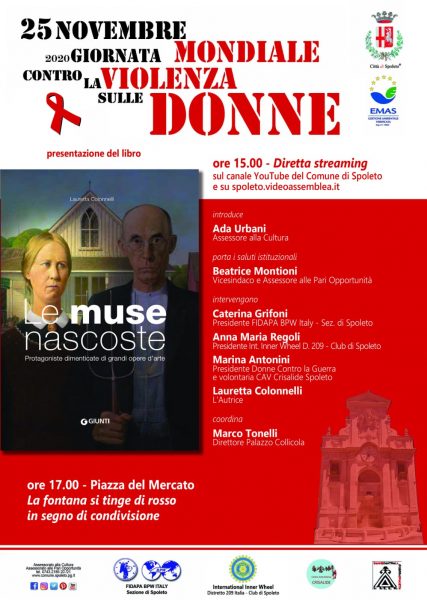
To mark International Women’s Day, the City of Spoleto has organised four events on Monday 8 and Tuesday 9 March.
The programme, which can be followed by videoconference and in streaming on the social channels of the Authority (Facebook and YouTube), includes two conferences, a concert and a short film dedicated to Italian theatres.
The first appointment will be with Women in Institutions, a conference that will be broadcast live via streaming on the City’s YouTube channel (https://bit.ly/38alu7b) on Monday 8 March at 4 p.m.. The meeting, which will be coordinated by the deputy mayor and councillor for equal opportunities Beatrice Montioni and the councillor for culture Ada Urbani, will be attended by Paola Agabiti (councillor of the Umbria Region), Elisa Sabbatini (mayor of Castel Ritaldi), Roberta Galassi (school manager), Candia Marcucci (director of the Umbrian Reclamation Consortium) and Emilia Bellina (former President of the Court of Spoleto).
As part of the “Musica c’è” project, on Monday 8 March at 6 p.m. there will be a concert entitled Women in music by the teachers of the “A. Onofri” Spoleto School of Music and Dance with Mariangela Campoccia (soprano) and Simona Granelli (piano). The concert will be broadcast on the city’s Facebook page (https://www.facebook.com/ComunediSpoleto).
On Tuesday 9 March at 4 p.m. the conference Women and sport: from myth to modernity will be broadcast live on YouTube. Participants include Beatrice Montioni (deputy mayor and councillor for equal opportunities), Caterina Grifoni (president FIDAPA BPW Italy, Spoleto section) and Romanella Gentili Bistoni (past president FIDAPA BPW Italy, Alta Valle del Tevere section).
The last appointment (9 March at 6 p.m.) will be the short film dedicated to all Italian theatres Applausi. Eco-sustainable haute couture rekindles the stage lights with Giorgia Battistoni, Yuri Napoli, Fabiola Gaudio (violin) and Maestro Lorenzo Porzio (music and piano). The short film is produced by Multimedia Communication, directed by Matteo Cuccu and the screenplay by Maria Costici.
“Despite the restrictions and the impossibility of organising, as in the past, a programme of appointments to be lived in presence – said deputy mayor Beatrice Montioni – we managed to realise two occasions of confrontation on the role of women in institutions and in the world of sport, with the intention of providing everyone with elements of knowledge and food for thought useful for understanding the value of gender equality, in a context in which the persistence of discrimination against women and girls is not only a violation of a fundamental human right, but is also a limitation to the achievement of the condition necessary to finally have a prosperous, sustainable and peaceful world.”
Monday 8 and Tuesday 9 March: four events streamed on YouTube and Facebook
To mark International Women’s Day, the City of Spoleto has organised four events on Monday 8 and Tuesday 9 March.
The programme, which can be followed by videoconference and in streaming on the social channels of the Authority (Facebook and YouTube), includes two conferences, a concert and a short film dedicated to Italian theatres.
The first appointment will be with Women in Institutions, a conference that will be broadcast live via streaming on the City’s YouTube channel (https://bit.ly/38alu7b) on Monday 8 March at 4 p.m.. The meeting, which will be coordinated by the deputy mayor and councillor for equal opportunities Beatrice Montioni and the councillor for culture Ada Urbani, will be attended by Paola Agabiti (councillor of the Umbria Region), Elisa Sabbatini (mayor of Castel Ritaldi), Roberta Galassi (school manager), Candia Marcucci (director of the Umbrian Reclamation Consortium) and Emilia Bellina (former President of the Court of Spoleto).
As part of the “Musica c’è” project, on Monday 8 March at 6 p.m. there will be a concert entitled Women in music by the teachers of the “A. Onofri” Spoleto School of Music and Dance with Mariangela Campoccia (soprano) and Simona Granelli (piano). The concert will be broadcast on the city’s Facebook page (https://www.facebook.com/ComunediSpoleto).
On Tuesday 9 March at 4 p.m. the conference Women and sport: from myth to modernity will be broadcast live on YouTube. Participants include Beatrice Montioni (deputy mayor and councillor for equal opportunities), Caterina Grifoni (president FIDAPA BPW Italy, Spoleto section) and Romanella Gentili Bistoni (past president FIDAPA BPW Italy, Alta Valle del Tevere section).
The last appointment (9 March at 6 p.m.) will be the short film dedicated to all Italian theatres Applausi. Eco-sustainable haute couture rekindles the stage lights with Giorgia Battistoni, Yuri Napoli, Fabiola Gaudio (violin) and Maestro Lorenzo Porzio (music and piano). The short film is produced by Multimedia Communication, directed by Matteo Cuccu and the screenplay by Maria Costici.
“Despite the restrictions and the impossibility of organising, as in the past, a programme of appointments to be lived in presence – said deputy mayor Beatrice Montioni – we managed to realise two occasions of confrontation on the role of women in institutions and in the world of sport, with the intention of providing everyone with elements of knowledge and food for thought useful for understanding the value of gender equality, in a context in which the persistence of discrimination against women and girls is not only a violation of a fundamental human right, but is also a limitation to the achievement of the condition necessary to finally have a prosperous, sustainable and peaceful world.”
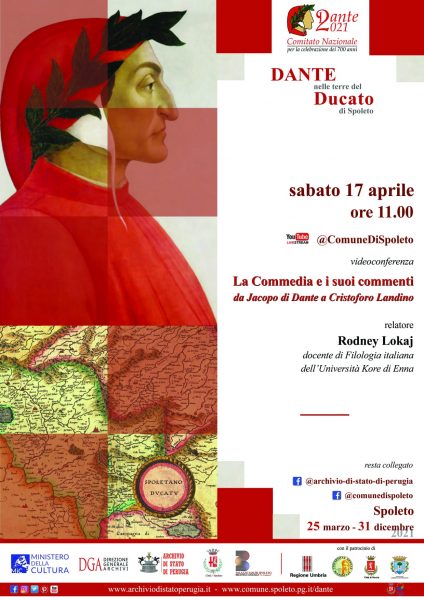
Included in the Dante in the Lands of the Duchy initiatives organised by the “Giosuè Carducci” City Library and the State Archives of Perugia on the occasion of the 700th anniversary of the death of Dante Alighieri, on Saturday 17 April at 11.00 a.m. Prof. Rodney Lokaj, professor of Italian philology at the University of Enna “Kore”, will hold a videoconference on the Divine Comedy and its commentaries, a long exegetical tradition that has accompanied Dante’s masterpiece since the death of the “Greatest Poet”.
Prof. Lokaj’s lecture covers a period of time that goes from Jacopo Alighieri’s commentary to Cristoforo Landino’s very successful one, son of the culture of Neoplatonism, of which the Carducci library preserves a precious incunabulum dated 1484.
Rodney Lokaj’s videoconference will be available on the Facebook and YouTube channels of the City of Spoleto.
A second lecture by Prof. Lokaj will be dedicated, in the coming months, to the figure of Giovanni di ser Buccio, a scholar from Spoleto who was among the commentators of the Commedia in the early 1400s.
The programme of initiatives of “Dante in the lands of the Duchy”, opened last March with the inauguration, in the covered courtyard of Palazzo Mauri, of an exhibition of incunabula, sixteenth-century editions, precious illustrated editions, maps and documents with specific reference to the relationship between Dante and the territory of Spoleto, will continue until December 2021 with conferences, concerts, readings aloud, activities with schools, to conclude with the publication of a catalogue.
Reading paths on Dante among the library’s new acquisitions. For those who want to take reading paths on Dante and the Comedy, the Carducci Library indicates some recently published books, among the new volumes available for loan.
Two great scholars of Italian literature, Marco Santagata and Giulio Ferroni, deal with the Divine Comedy, the first offering a useful guide to orientate oneself in the vast universe of the allegorical poem, the second literally making a journey in stages along the peninsula, to sound out the geography and the many places treated or cited in the work. Dante’s encyclopaedic culture and attention to nature are revealed in a text by Angelo Manitta that deals with botany and plants in the Comedy. One of the most highly regarded historians of our time, Alessandro Barbero chisels out a portrait of Dante focusing on his dimension as a man of the Middle Ages. There is also an ironic reinterpretation of Dante’s Inferno by Tommaso Cerno who, aided by Makkox’s biting drawings, recounts the politics and power of Italy at the dawn of the Third Republic.
Rodney Lokaj’s CV. A graduate of Melbourne and Perugia, former student of the classical philologist and Dante scholar Giorgio Brugnoli in Rome, Rodney Lokaj is of Australian origin but a naturalised Italian. He is currently Professor of Italian Philology at the University of Enna ‘Kore’ in Sicily, known worldwide as a scholar of Franciscanism, Dante, Petrarch, Castiglione, Falcone, Bembo, Humanism and the reception of the classical tradition. On Dante, in particular, he has published on the illustrious vernacular, Gianni Schicchi, Piccarda Donati, Saint Francis, and the Veltro. He regularly participates in international conferences in Italy, Europe, North America and Australia. He has long-standing collaborations with the Vatican Library, the State Archives of Perugia, the Saint of Padua, in Poland, China and Spain. He is a member of the scientific committee of numerous journals and scientific academies at national and international level, including: the Deputazione di Storia Patria per l’Umbria, the Società Dantesca Italiana, the executive committee of the North American Society of Neo-Latin Studies. He has collaborated on numerous projects at the Giosuè Carducci Library in Palazzo Mauri, including the Lecturae Dantis.
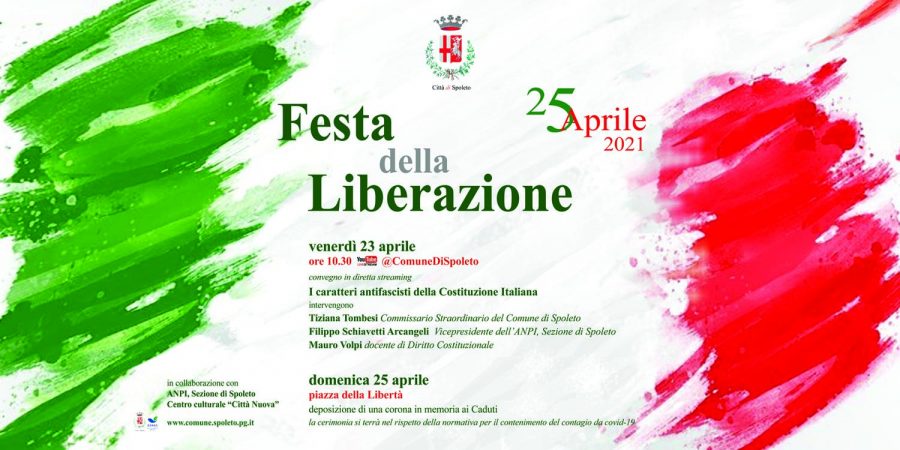
On the occasion of the 76th FEAST OF LIBERATION, the city administration, in collaboration with the Spoleto section of the National Partizans’ Association (ANPI) and the “Città Nuova” cultural centre, has organised a conference on Friday 23 April 2021 at 10.30 a.m. entitled Anti-fascist characteristics of the Italian Constitution.
The meeting will be attended by the Extraordinary Commissioner of the City of Spoleto, Dr Tiziana Tombesi, the vice-president of the ANPI section of Spoleto, Filippo Schiavetti Arcangeli, and Professor Mauro Volpi, professor of constitutional law.
The conference, which will be attended by high school students, will be streamed live on the YouTube channel of the City of Spoleto >>https://bit.ly/3apTxtg.
On Sunday 25 April, in accordance with the requirements of the health emergency, a laurel wreath will be laid in Piazza della Libertà (palazzetto Ancaiani) in honour of those who fell in the Liberation War.


75th Edition of the “Comunità Europea” Competition For Young Opera Singers
organised by Teatro Lirico Sperimentale “A. Belli”.
Jury chaired by Mariella Devia
Renato Bruson among the Jury Members
May 5-8, 2021, Teatro Nuovo
Under the auspices of the Ministry of Culture, Regione Umbria, Comune di Spoleto, Fondazione Cassa di Risparmio di Spoleto, Fondazione Francesca, Valentina e Luigi Antonini and with the patronage of the Commission of the European Communities, the Teatro Lirico Sperimentale di Spoleto “A. Belli” announces the 75th edition of the “Comunità Europea” Competition for Young Opera Singers.
The competition is open to young people who, on 1 January 2021, are under 32 years of age (sopranos and tenors) and under 34 years of age for mezzo-sopranos, contraltos, baritones and basses, who are citizens of EU countries, EFTA countries (Iceland, Liechtenstein, Norway, Switzerland), citizens of candidate countries for accession to the EU or potential candidates for accession to the EU, and countries participating in the European cultural programmes “Creative Europe” on 03.02.2021 (Albania, Republic of North Macedonia, Montenegro, UK, Republic of Serbia, Armenia, Tunisia, Bosnia and Herzegovina, Moldova, Georgia, Ukraine and Kosovo under UN Security Council Resolution 1244 of the United Nations Security Council).
President of the Jury will be acclaimed soprano Mariella Devia. The Jury will also feature experts in the field, including Renato Bruson, and representatives of the Artistic Direction of the Institution, as per Art. 5 of the Competition Notice, M° Michelangelo Zurletti, musicologist and music critic and Enrico Girardi, music critic of the Corriere della Sera and Professor at the Università Cattolica del Sacro Cuore in Milan.
The winners of the competition (all those who have obtained a minimum score of 8/10) will take part in a two-year, five-month STUDY COURSE that will prepare them for their theatre debut. Among the teachers of the Corso di Avviamento al Debutto 2021 are: for vocal interpretation Renato Bruson and Marina Comparato, for acting Giorgio Bongiovanni and Andrea Stanisci, for score study Raffaele Cortesi, Enza Ferrari and Carlo Palleschi. Lessons on music and entertainment legislation and a teaching module on artists’ rights are also scheduled. Individual STUDY GRANTS of 700.00 euros gross per month are available. At the end of the course the winners will make their debut in the 2021 SEASON of the “Sperimentale”, which will take place as usual in September.
The conduct and organisation of the Competition, of the free auditions, of the examinations themselves, of the didactic exercises, of the concerts, of the Debut Training Course and of the “Sperimentale di Spoleto e dell’Umbria” Opera Season, are subject to the provisions that will be in force at the time of the Competition itself, of the Course, of the Opera Season and of the other activities mentioned above, and issued by the competent authorities of the Republic of Italy.
For 2021, a special prize for the 75th anniversary of the Teatro Lirico Sperimentale is established for the first three winners, based on the score assigned by the jury. The grant will be awarded according to the modalities indicated in art. 10 of the Competition Notice.
Applications must be sent by e-mail to segreteria.artistica@tls-belli.it or by post to: Teatro Lirico Sperimentale di Spoleto “A. Belli”, Piazza G. Bovio 1, 06049 Spoleto (PG) by 22 April 2021. The competition, which will take place at the Teatro Nuovo in Spoleto, will be held from 5 to 8 May 2021. For singers over the age limit of the competition and for citizens of countries not included in art.1 of the announcement, free auditions connected to the Singing Competition will be held on 9 and 10 May 2021. Further information: https://www.tls-belli.it/libere-audizioni/.
The competition’s detailed information and announcements can be obtained from:
Teatro Lirico Sperimentale di Spoleto “A. Belli”
Piazza G. Bovio, 1 – 06049 SPOLETO (PG)
Tel – 0743 221645
Fax 0743 222930
segreteria.artistica@tls-belli.it
segreteria@tls-belli.it




From June 15 to November 7, thanks to the precious collaboration of the Vatican Museums, the triptych composed of the Madonna Enthroned with Child and Angels, currently housed in the Diocesan Museum of Spoleto, and the side compartments with the depictions of Saint Paula of Rome and Saint Eustochio, which escaped the fury of the 1703 earthquake, will be reunited and will be visible for the first time.
The exhibition, entitled Late gothic enchantment. The recomposed triptych of the Master of the Straus Madonna, is curated by Adele Breda, referent of the Department for Byzantine-Medieval Art of the Vatican Museums, by Stefania Nardicchi, Curator of the Diocesan Museum of Spoleto, and by Anna Pizzamano, PhD student in “History and Cultural Heritage of the Church” at the Pontifical Gregorian University.
On the occasion of the recent restoration of the two side compartments preserved in the Vatican Collection, bearing the images of two little-known saints, Paola of Rome and Eustochio, mother and daughter who lived at the time of St. Jerome (late fourth century), their study was deepened and an attempt was made to find the lost central compartment. The searches led to the Diocesan Museum, where a fragmented table representing a Madonna in throne with the Child between two angels has been identified. The painting, even if missing the lower part, has been recognized as the central part of the triptych. The work adorned in origin the altar of the church of Saint Maria near the castle of Abeto di Preci, from which the name of Maria Santissima di Piè di Castello.
The Madonna di Spoleto was transferred to the Vatican Museums’ Office of Scientific Researches applied to Cultural Heritage, where the various components were thoroughly examined: the wooden essence, the pigments, the engravings and the punches confirmed its full compatibility. With the intention of deepening the study of a painter of very high quality who is not sufficiently known, a later work by the same master was also selected for comparison, the Madonna Enthroned with Child between Two Angels, today kept in the Museum of Sacred Art and Popular Religiousness “Beato Angelico” in Vicchio del Mugello.
There are several reasons that led to this choice. These polyptychs are in fact made by one of the most refined and sought-after Florentine workshops of the time, and used for the liturgical decoration of chapels and parishes in the rural areas of Umbria and Tuscany. The survival of the only table with the Madonna, both in the case of Abeto di Preci and in that of Vicchio, attests, moreover, a devotion never interrupted and an affective and plurisecular bond with the territory, that has resisted also to the dispersion of the side compartments. Thanks to this juxtaposition it is also possible to guess the original dimensions of the Madonna in Spoleto, seriously damaged in the earthquake of 1703.
These works represent two different moments of the stylistic path of the Master of the Straus Madonna, active in Florence between 1385 and 1415, a painter who, from an initial neo-Giottism, slowly opened to the new international style, welcoming in part the style of Lorenzo Monaco and Gherardo Starnina, but always maintaining his original archaic style.
Title: Late Gothic Enchantment, The recomposed triptych of the Master of the Straus Madonna
Venue: Spoleto, Diocesan Museum
Period: 15 June -7 November 2021
Catalog: published by Quattroemme, Perugia
Hours: Every day from 11 to 18. Closed on Mondays.
Tickets: Euro 5,00; free of charge up to 6 years old and disabled people with accompanying person
Information:
Ph.+39 0577 286300 – duomospoleto@operalaboratori.com
www.spoletonorcia.it
From June 15 to November 7, thanks to the precious collaboration of the Vatican Museums, the triptych composed of the Madonna Enthroned with Child and Angels, currently housed in the Diocesan Museum of Spoleto, and the side compartments with the depictions of Saint Paula of Rome and Saint Eustochio, which escaped the fury of the 1703 earthquake, will be reunited and will be visible for the first time.
The exhibition, entitled Late gothic enchantment. The recomposed triptych of the Master of the Straus Madonna, is curated by Adele Breda, referent of the Department for Byzantine-Medieval Art of the Vatican Museums, by Stefania Nardicchi, Curator of the Diocesan Museum of Spoleto, and by Anna Pizzamano, PhD student in “History and Cultural Heritage of the Church” at the Pontifical Gregorian University.
On the occasion of the recent restoration of the two side compartments preserved in the Vatican Collection, bearing the images of two little-known saints, Paola of Rome and Eustochio, mother and daughter who lived at the time of St. Jerome (late fourth century), their study was deepened and an attempt was made to find the lost central compartment. The searches led to the Diocesan Museum, where a fragmented table representing a Madonna in throne with the Child between two angels has been identified. The painting, even if missing the lower part, has been recognized as the central part of the triptych. The work adorned in origin the altar of the church of Saint Maria near the castle of Abeto di Preci, from which the name of Maria Santissima di Piè di Castello.
The Madonna di Spoleto was transferred to the Vatican Museums’ Office of Scientific Researches applied to Cultural Heritage, where the various components were thoroughly examined: the wooden essence, the pigments, the engravings and the punches confirmed its full compatibility. With the intention of deepening the study of a painter of very high quality who is not sufficiently known, a later work by the same master was also selected for comparison, the Madonna Enthroned with Child between Two Angels, today kept in the Museum of Sacred Art and Popular Religiousness “Beato Angelico” in Vicchio del Mugello.
There are several reasons that led to this choice. These polyptychs are in fact made by one of the most refined and sought-after Florentine workshops of the time, and used for the liturgical decoration of chapels and parishes in the rural areas of Umbria and Tuscany. The survival of the only table with the Madonna, both in the case of Abeto di Preci and in that of Vicchio, attests, moreover, a devotion never interrupted and an affective and plurisecular bond with the territory, that has resisted also to the dispersion of the side compartments. Thanks to this juxtaposition it is also possible to guess the original dimensions of the Madonna in Spoleto, seriously damaged in the earthquake of 1703.
These works represent two different moments of the stylistic path of the Master of the Straus Madonna, active in Florence between 1385 and 1415, a painter who, from an initial neo-Giottism, slowly opened to the new international style, welcoming in part the style of Lorenzo Monaco and Gherardo Starnina, but always maintaining his original archaic style.
Title: Late Gothic Enchantment, The recomposed triptych of the Master of the Straus Madonna
Venue: Spoleto, Diocesan Museum
Period: 15 June -7 November 2021
Catalog: published by Quattroemme, Perugia
Hours: Every day from 11 to 18. Closed on Mondays.
Tickets: Euro 5,00; free of charge up to 6 years old and disabled people with accompanying person
Information:
Ph.+39 0577 286300 – duomospoleto@operalaboratori.com
www.spoletonorcia.it
From June 15 to November 7, thanks to the precious collaboration of the Vatican Museums, the triptych composed of the Madonna Enthroned with Child and Angels, currently housed in the Diocesan Museum of Spoleto, and the side compartments with the depictions of Saint Paula of Rome and Saint Eustochio, which escaped the fury of the 1703 earthquake, will be reunited and will be visible for the first time.
The exhibition, entitled Late gothic enchantment. The recomposed triptych of the Master of the Straus Madonna, is curated by Adele Breda, referent of the Department for Byzantine-Medieval Art of the Vatican Museums, by Stefania Nardicchi, Curator of the Diocesan Museum of Spoleto, and by Anna Pizzamano, PhD student in “History and Cultural Heritage of the Church” at the Pontifical Gregorian University.
On the occasion of the recent restoration of the two side compartments preserved in the Vatican Collection, bearing the images of two little-known saints, Paola of Rome and Eustochio, mother and daughter who lived at the time of St. Jerome (late fourth century), their study was deepened and an attempt was made to find the lost central compartment. The searches led to the Diocesan Museum, where a fragmented table representing a Madonna in throne with the Child between two angels has been identified. The painting, even if missing the lower part, has been recognized as the central part of the triptych. The work adorned in origin the altar of the church of Saint Maria near the castle of Abeto di Preci, from which the name of Maria Santissima di Piè di Castello.
The Madonna di Spoleto was transferred to the Vatican Museums’ Office of Scientific Researches applied to Cultural Heritage, where the various components were thoroughly examined: the wooden essence, the pigments, the engravings and the punches confirmed its full compatibility. With the intention of deepening the study of a painter of very high quality who is not sufficiently known, a later work by the same master was also selected for comparison, the Madonna Enthroned with Child between Two Angels, today kept in the Museum of Sacred Art and Popular Religiousness “Beato Angelico” in Vicchio del Mugello.
There are several reasons that led to this choice. These polyptychs are in fact made by one of the most refined and sought-after Florentine workshops of the time, and used for the liturgical decoration of chapels and parishes in the rural areas of Umbria and Tuscany. The survival of the only table with the Madonna, both in the case of Abeto di Preci and in that of Vicchio, attests, moreover, a devotion never interrupted and an affective and plurisecular bond with the territory, that has resisted also to the dispersion of the side compartments. Thanks to this juxtaposition it is also possible to guess the original dimensions of the Madonna in Spoleto, seriously damaged in the earthquake of 1703.
These works represent two different moments of the stylistic path of the Master of the Straus Madonna, active in Florence between 1385 and 1415, a painter who, from an initial neo-Giottism, slowly opened to the new international style, welcoming in part the style of Lorenzo Monaco and Gherardo Starnina, but always maintaining his original archaic style.
Title: Late Gothic Enchantment, The recomposed triptych of the Master of the Straus Madonna
Venue: Spoleto, Diocesan Museum
Period: 15 June -7 November 2021
Catalog: published by Quattroemme, Perugia
Hours: Every day from 11 to 18. Closed on Mondays.
Tickets: Euro 5,00; free of charge up to 6 years old and disabled people with accompanying person
Information:
Ph.+39 0577 286300 – duomospoleto@operalaboratori.com
www.spoletonorcia.it
From June 15 to November 7, thanks to the precious collaboration of the Vatican Museums, the triptych composed of the Madonna Enthroned with Child and Angels, currently housed in the Diocesan Museum of Spoleto, and the side compartments with the depictions of Saint Paula of Rome and Saint Eustochio, which escaped the fury of the 1703 earthquake, will be reunited and will be visible for the first time.
The exhibition, entitled Late gothic enchantment. The recomposed triptych of the Master of the Straus Madonna, is curated by Adele Breda, referent of the Department for Byzantine-Medieval Art of the Vatican Museums, by Stefania Nardicchi, Curator of the Diocesan Museum of Spoleto, and by Anna Pizzamano, PhD student in “History and Cultural Heritage of the Church” at the Pontifical Gregorian University.
On the occasion of the recent restoration of the two side compartments preserved in the Vatican Collection, bearing the images of two little-known saints, Paola of Rome and Eustochio, mother and daughter who lived at the time of St. Jerome (late fourth century), their study was deepened and an attempt was made to find the lost central compartment. The searches led to the Diocesan Museum, where a fragmented table representing a Madonna in throne with the Child between two angels has been identified. The painting, even if missing the lower part, has been recognized as the central part of the triptych. The work adorned in origin the altar of the church of Saint Maria near the castle of Abeto di Preci, from which the name of Maria Santissima di Piè di Castello.
The Madonna di Spoleto was transferred to the Vatican Museums’ Office of Scientific Researches applied to Cultural Heritage, where the various components were thoroughly examined: the wooden essence, the pigments, the engravings and the punches confirmed its full compatibility. With the intention of deepening the study of a painter of very high quality who is not sufficiently known, a later work by the same master was also selected for comparison, the Madonna Enthroned with Child between Two Angels, today kept in the Museum of Sacred Art and Popular Religiousness “Beato Angelico” in Vicchio del Mugello.
There are several reasons that led to this choice. These polyptychs are in fact made by one of the most refined and sought-after Florentine workshops of the time, and used for the liturgical decoration of chapels and parishes in the rural areas of Umbria and Tuscany. The survival of the only table with the Madonna, both in the case of Abeto di Preci and in that of Vicchio, attests, moreover, a devotion never interrupted and an affective and plurisecular bond with the territory, that has resisted also to the dispersion of the side compartments. Thanks to this juxtaposition it is also possible to guess the original dimensions of the Madonna in Spoleto, seriously damaged in the earthquake of 1703.
These works represent two different moments of the stylistic path of the Master of the Straus Madonna, active in Florence between 1385 and 1415, a painter who, from an initial neo-Giottism, slowly opened to the new international style, welcoming in part the style of Lorenzo Monaco and Gherardo Starnina, but always maintaining his original archaic style.
Title: Late Gothic Enchantment, The recomposed triptych of the Master of the Straus Madonna
Venue: Spoleto, Diocesan Museum
Period: 15 June -7 November 2021
Catalog: published by Quattroemme, Perugia
Hours: Every day from 11 to 18. Closed on Mondays.
Tickets: Euro 5,00; free of charge up to 6 years old and disabled people with accompanying person
Information:
Ph.+39 0577 286300 – duomospoleto@operalaboratori.com
www.spoletonorcia.it

On Friday 18 June, at 5 p.m., in the former church of Sant’Agata, next to the National Archaeological Museum of Spoleto and the Roman Theatre, the book by Rossano De Cesaris “Trucco e bellezza nell’antichità” (published by Sillabe) will be presented.
A journey through the Egyptians, Cretans, Mycenaeans, Etruscans, Romans and Byzantines in the company of the famous make-up artist to discover the secrets of beauty. A detailed analysis of the distinctive and characteristic traits of each civilisation, trying to trace, where possible, parallels with the current era and an identity that links us to the ancients. This will be followed by a free guided tour of some of the fashion and beauty exhibits in the museum’s collections and storage areas.
Free admission. Reservations are recommended by calling 0743 223277 or sending an email to drm-umb.muspoleto@beniculturali.it.
This is the first of the events organised by director Silvia Casciarri on the occasion of the European Archaeology Days (18-19-20 June 2021).
From June 15 to November 7, thanks to the precious collaboration of the Vatican Museums, the triptych composed of the Madonna Enthroned with Child and Angels, currently housed in the Diocesan Museum of Spoleto, and the side compartments with the depictions of Saint Paula of Rome and Saint Eustochio, which escaped the fury of the 1703 earthquake, will be reunited and will be visible for the first time.
The exhibition, entitled Late gothic enchantment. The recomposed triptych of the Master of the Straus Madonna, is curated by Adele Breda, referent of the Department for Byzantine-Medieval Art of the Vatican Museums, by Stefania Nardicchi, Curator of the Diocesan Museum of Spoleto, and by Anna Pizzamano, PhD student in “History and Cultural Heritage of the Church” at the Pontifical Gregorian University.
On the occasion of the recent restoration of the two side compartments preserved in the Vatican Collection, bearing the images of two little-known saints, Paola of Rome and Eustochio, mother and daughter who lived at the time of St. Jerome (late fourth century), their study was deepened and an attempt was made to find the lost central compartment. The searches led to the Diocesan Museum, where a fragmented table representing a Madonna in throne with the Child between two angels has been identified. The painting, even if missing the lower part, has been recognized as the central part of the triptych. The work adorned in origin the altar of the church of Saint Maria near the castle of Abeto di Preci, from which the name of Maria Santissima di Piè di Castello.
The Madonna di Spoleto was transferred to the Vatican Museums’ Office of Scientific Researches applied to Cultural Heritage, where the various components were thoroughly examined: the wooden essence, the pigments, the engravings and the punches confirmed its full compatibility. With the intention of deepening the study of a painter of very high quality who is not sufficiently known, a later work by the same master was also selected for comparison, the Madonna Enthroned with Child between Two Angels, today kept in the Museum of Sacred Art and Popular Religiousness “Beato Angelico” in Vicchio del Mugello.
There are several reasons that led to this choice. These polyptychs are in fact made by one of the most refined and sought-after Florentine workshops of the time, and used for the liturgical decoration of chapels and parishes in the rural areas of Umbria and Tuscany. The survival of the only table with the Madonna, both in the case of Abeto di Preci and in that of Vicchio, attests, moreover, a devotion never interrupted and an affective and plurisecular bond with the territory, that has resisted also to the dispersion of the side compartments. Thanks to this juxtaposition it is also possible to guess the original dimensions of the Madonna in Spoleto, seriously damaged in the earthquake of 1703.
These works represent two different moments of the stylistic path of the Master of the Straus Madonna, active in Florence between 1385 and 1415, a painter who, from an initial neo-Giottism, slowly opened to the new international style, welcoming in part the style of Lorenzo Monaco and Gherardo Starnina, but always maintaining his original archaic style.
Title: Late Gothic Enchantment, The recomposed triptych of the Master of the Straus Madonna
Venue: Spoleto, Diocesan Museum
Period: 15 June -7 November 2021
Catalog: published by Quattroemme, Perugia
Hours: Every day from 11 to 18. Closed on Mondays.
Tickets: Euro 5,00; free of charge up to 6 years old and disabled people with accompanying person
Information:
Ph.+39 0577 286300 – duomospoleto@operalaboratori.com
www.spoletonorcia.it
Saturday 19 June, 4.30 p.m.
Hidden Treasures from Piazza d’Armi
Presentation at the National Archaeological Museum of Spoleto and Roman Theatre of the hidden treasures from Piazza d’Armi
On the occasion of the European Archaeology Days, there will be a preview of extraordinary finds from some of the tombs in the necropolis. The director Silvia Casciarri and the restorer Giacomo Perna, who supervised the excavation work, will speak.
Booking required: 0743.223277 – e-mail: drm-umb.muspoleto@beniculturali.it
From June 15 to November 7, thanks to the precious collaboration of the Vatican Museums, the triptych composed of the Madonna Enthroned with Child and Angels, currently housed in the Diocesan Museum of Spoleto, and the side compartments with the depictions of Saint Paula of Rome and Saint Eustochio, which escaped the fury of the 1703 earthquake, will be reunited and will be visible for the first time.
The exhibition, entitled Late gothic enchantment. The recomposed triptych of the Master of the Straus Madonna, is curated by Adele Breda, referent of the Department for Byzantine-Medieval Art of the Vatican Museums, by Stefania Nardicchi, Curator of the Diocesan Museum of Spoleto, and by Anna Pizzamano, PhD student in “History and Cultural Heritage of the Church” at the Pontifical Gregorian University.
On the occasion of the recent restoration of the two side compartments preserved in the Vatican Collection, bearing the images of two little-known saints, Paola of Rome and Eustochio, mother and daughter who lived at the time of St. Jerome (late fourth century), their study was deepened and an attempt was made to find the lost central compartment. The searches led to the Diocesan Museum, where a fragmented table representing a Madonna in throne with the Child between two angels has been identified. The painting, even if missing the lower part, has been recognized as the central part of the triptych. The work adorned in origin the altar of the church of Saint Maria near the castle of Abeto di Preci, from which the name of Maria Santissima di Piè di Castello.
The Madonna di Spoleto was transferred to the Vatican Museums’ Office of Scientific Researches applied to Cultural Heritage, where the various components were thoroughly examined: the wooden essence, the pigments, the engravings and the punches confirmed its full compatibility. With the intention of deepening the study of a painter of very high quality who is not sufficiently known, a later work by the same master was also selected for comparison, the Madonna Enthroned with Child between Two Angels, today kept in the Museum of Sacred Art and Popular Religiousness “Beato Angelico” in Vicchio del Mugello.
There are several reasons that led to this choice. These polyptychs are in fact made by one of the most refined and sought-after Florentine workshops of the time, and used for the liturgical decoration of chapels and parishes in the rural areas of Umbria and Tuscany. The survival of the only table with the Madonna, both in the case of Abeto di Preci and in that of Vicchio, attests, moreover, a devotion never interrupted and an affective and plurisecular bond with the territory, that has resisted also to the dispersion of the side compartments. Thanks to this juxtaposition it is also possible to guess the original dimensions of the Madonna in Spoleto, seriously damaged in the earthquake of 1703.
These works represent two different moments of the stylistic path of the Master of the Straus Madonna, active in Florence between 1385 and 1415, a painter who, from an initial neo-Giottism, slowly opened to the new international style, welcoming in part the style of Lorenzo Monaco and Gherardo Starnina, but always maintaining his original archaic style.
Title: Late Gothic Enchantment, The recomposed triptych of the Master of the Straus Madonna
Venue: Spoleto, Diocesan Museum
Period: 15 June -7 November 2021
Catalog: published by Quattroemme, Perugia
Hours: Every day from 11 to 18. Closed on Mondays.
Tickets: Euro 5,00; free of charge up to 6 years old and disabled people with accompanying person
Information:
Ph.+39 0577 286300 – duomospoleto@operalaboratori.com
www.spoletonorcia.it
