

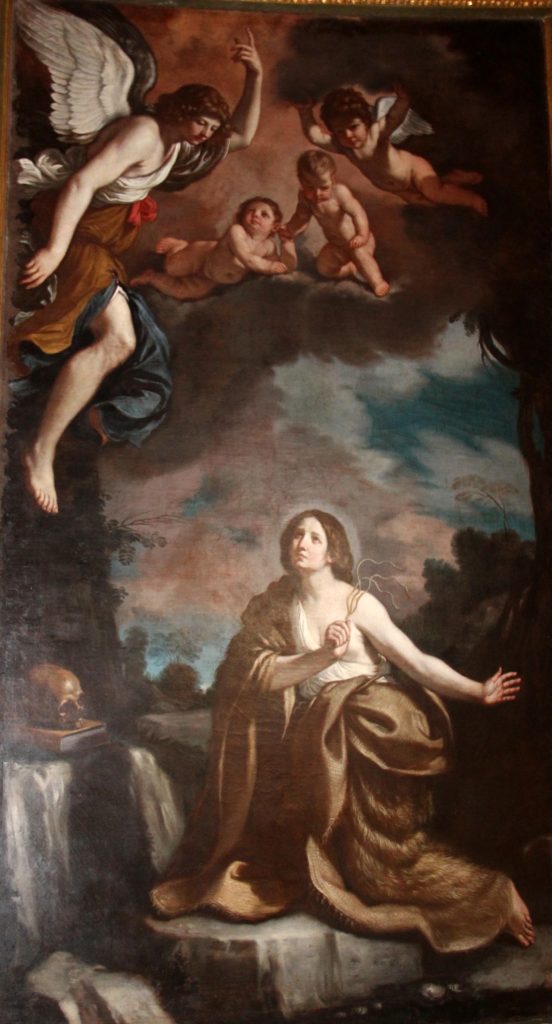
The work had been commissioned by Spoletan Alfonso Palettoni when he was governor in Cento and was possibly in Spoleto already since the 17th century, given by the heirs to the local Magdalene congregation. Palettoni certainly attended Guercino’s workshop, as testified to by the Barbieri brothers’ Libro dei conti, that certifies a number of payments by the Spoletan govenor, including that in favour of Guercino’s brother Paolo Antonio who authored the Spezieria, now on display at the piano nobile of Palazzo Collicola.
In 1861, following the Decreto Pepoli and the suppression of religious orders, to prevent the Magdalene from being confiscated, the congregation clandestinely removed and hid it behind Annibale Carracci’s painting by the right transept at the Duomo, where it was discovered anyway, then seized and brought to the Town Hall’s deposits.
Roughly halfway across the 19th century, Giovanni Catena was entrusted with the work’s restoration, on whose occasion the Spoletan painter made a copy for the church of the Magdalene.
The work is agreeingly identified by scholars as a study by Giovan Francesco Barbieri a.k.a. il Guercino, as in the master from Cento’s Libro dei conti, no link to the Spoletan Magdalene appears. While recognising the presence of his workshop in the quality of the execution, it is possible to refer the general approach to Guercino himself, specifically to that phase of his career characterised by “a paler, more pastel range of colours, and a more delicate type of workmanship” (D. Mahon).
The monumental character of the Penitent Magdalene‘s figure – a popular subject in those times – is portrayed while she’s scourging her own flesh, covered by a thick cloak and kneeling down on a stone. The saint interacts with the surrounding space in a balanced way, while a big angel and three putti encompass the composition, the former closing it on the left, the latter marking the passage from shadow to light on the right.
To learn more, please visit the “A tu per tu con l’arte” section of Palazzo Collicola here >> https://bit.ly/3cj6H9O
Sebastiano Conca (1680-1764)

The elegant painting featuring Madonna with Child and St John the Baptist on display at the sala verde of the piano nobile at Palazzo Collicola was created in 1746 by Sebastiano Conca, whose works, according to his contemporary biographers, appear in the private galleries and palaces of many Lords in Rome, and many have gone elsewhere, and especially to the countries beyond the Alps, and more so to England (Bernardo De Dominici, Vite de’ pittori, scultori, ed architetti napoletani, 1742-1745).
The painter, born in 1680 in Gaeta, studied in Naples in Francesco Solimena‘s workshop, during his career (mainly in Rome) was highly praised by foreign clients and collectionists, such as count of Leicester Thomas Coke, king Felipe V de España or Franz Lothar von Schönborn, archbishop in Mainz. Conca was among the protagonists of Roman painting during the 18th century’s second quarter, and along with Giaquinto, introduced Rococo in Umbria.
He executed a large group of works for Spoleto and probably stayed there, receiving various commissions from local families, such as the Ancaiani for whom he made a copy of a work by Lo Spagna; he also had a local follower, Nicola Costantini, who helped him make the canvases for the Church of the Manna d’Oro.
In this painting, dating from the period of the artist’s greatest activity for churches and families in Spoleto, the group of the Madonna with Child Jesus and St. John, set in a false oval, emerges from a dense vegetation through the graceful, elegant gestures of the figures by the serene and calm tones, enhanced by chromatic delicacy and soft shadows.
The work, a splendid example of the production for private use that constituted a minor yet not insignificant aspect of the painter’s activity, can perhaps be identified with the painting that Leonetti Luparini saw in the Corradi house in Spoleto. It was placed in the Civic Art Gallery in 1910.
To learn more, please visit the “A tu per tu con l’arte” section of Palazzo Collicola here >> https://bit.ly/3cj6H9O


