
I speak Langobardic
A new school year starts today, and Langobardic won’t certainly be among the foreign languages to be studied; but what is the position of this language in relation to Italian?
In the articles published in this column we have repeatedly spoken about the lack of written sources and also about how the Langobards entrusted their wealth of knowledge and customs to oral transmission. A lack of sources also with regard to texts written in this language.
The Langobards were of course a foreign people to the Italics when they entered the peninsula in 568. The Greek-Gothic war had ended just fifteen years earlier leaving Italy devastated, depopulated and impoverished. The Langobards, strong and well armed, were met with little to no resistance.
At first they replaced the remaining Roman elite, but soon the two ethnic groups started to merge. Langobard laws came to be an alternative to Roman law, and when in 643 Rotharis decided to collect them in writing, he had them written in Latin. There are, however, some Langobard words that have no Latin counterpart, specific terms that we still know, such as feud and weregild.
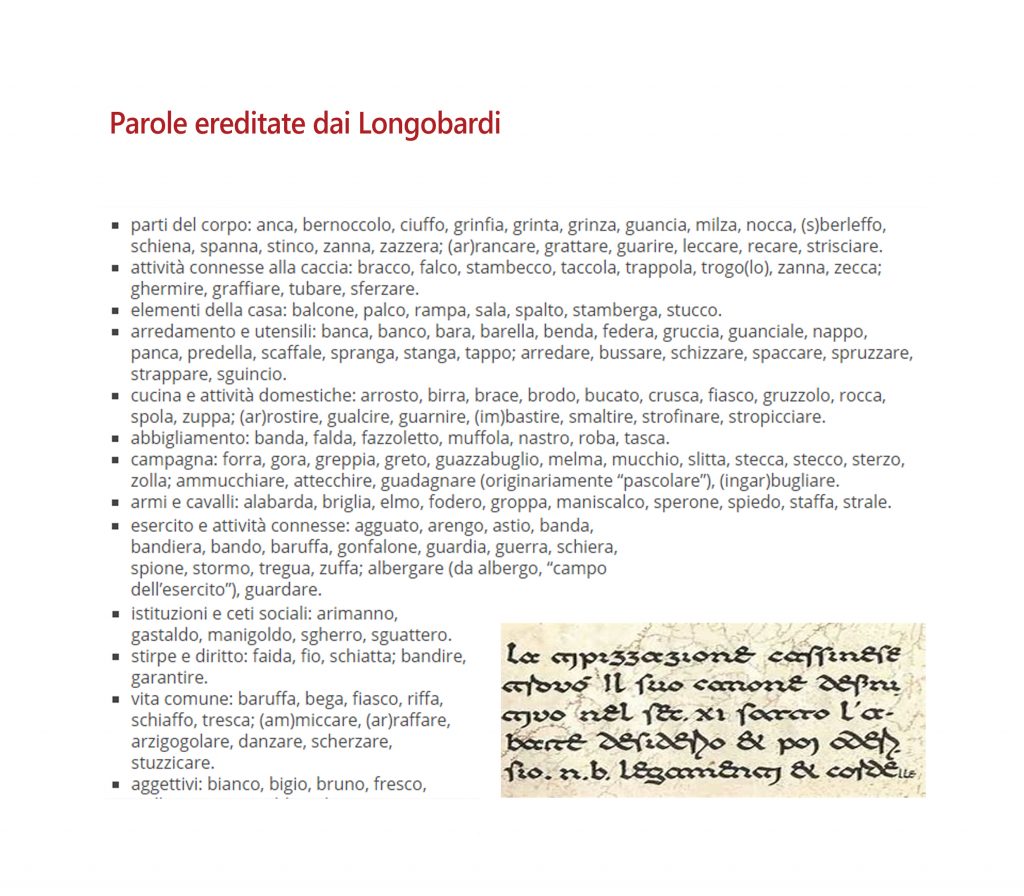
People were still speaking Latin at the time; certainly it was no longer the classical, cosmopolitan Latin that had ruled the world, but a language that had evolved to become the so-called Vulgar Latin; this was the language that received the Langobard inputs: not the high, incorruptible Latin of the learned, but the language of the common people.
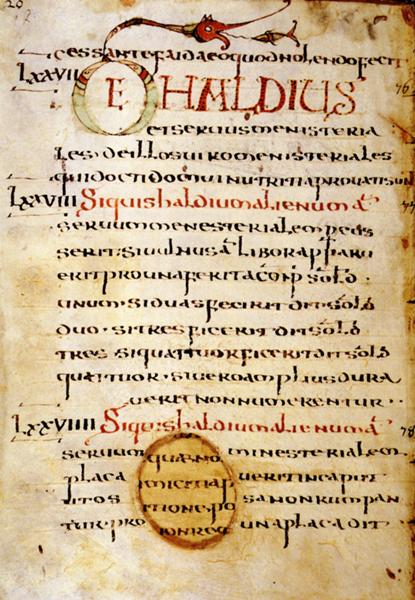
Still today, both in Italian and in the regional dialects, many Langobard words are still in use, mainly words of common use, part of our fundamental lexicon indeed. Very humble words, which define tools, craftsmanship, breeding, body parts, relationships and clashes.
But the Langobards also left us a series of proper names, such as Adelmo, Adolfo, Alberto, Aldo, Armando, Bernardo, Filiberto, Guido, Leopoldo, Matilde, Rodolfo, and Ubaldo.
Happy Monday with the Langobards!
NEWS ARCHIVES
- Thrasimund I | 7 September 2020
- The Langobards first-hand | 31 August 2020
- Atto: IV duke of Spoleto | 24 August 2020
- Theodelapius: duke of Spoleto | 10 August 2020
- The duchies of Spoleto and Benevento | 3 August 2020
- Ariulf, Spoleto’s 2nd duke | 27 July 2020
- The United Nations Educational, Scientific and Cultural Organization (UNESCO) | 20 July 2020
- The Langobards’ corner at Palazzo Mauri | 13 July 2020
- Mosaic at Palazzo Pianciani | 6 July 2020
- The Duchy of Spoleto: Palazzo Mauri | 29 June 2020
- Nine years ago, the inclusion in the World Heritage List (WHL) | 22 June 2020
- Two bishops | 15 June 2020
- The Duchy of Spoleto and the first Dux Faroald I | 8 June 2020
- Totem animals in the Langobards’ Imagination | 1 June 2020
- Knives and swords | 25 May 2020
- The warrior | 18 May 2020
- What a beard did these Langobards have!| 11 May 2020
- Intelligence in the hands | 4 May 2020
- The aurifex and the goldsmithing techniques in the Longobard period | 27 April 2020
- The aurifex and the importance of goldsmithing in the Duchy of Spoleto | 20 April 2020


