

1917: The Monteluco carriage road is built thanks to prisoners of war.
An integral part of Spoleto’s historical identity, a very ancient religious enclave, a mystical place since pagan times (“Lucus”), a wood protected by laws such as the “Lex Spoletina”, an anchorite and hermitic refuge for Christianity since the 5th century, Monteluco and its sacredness must bow before the flattery of modernity, when, in 1916-17, the City Administration decided to build a carriage road to easily connect the Ponte delle Torri area to the top of the mountain, breaking the centuries-old isolation of a meditative refuge that had seduced St. Francis and Michelangelo and opening up its solitary and silent woodlands to the whirlwind of cars.
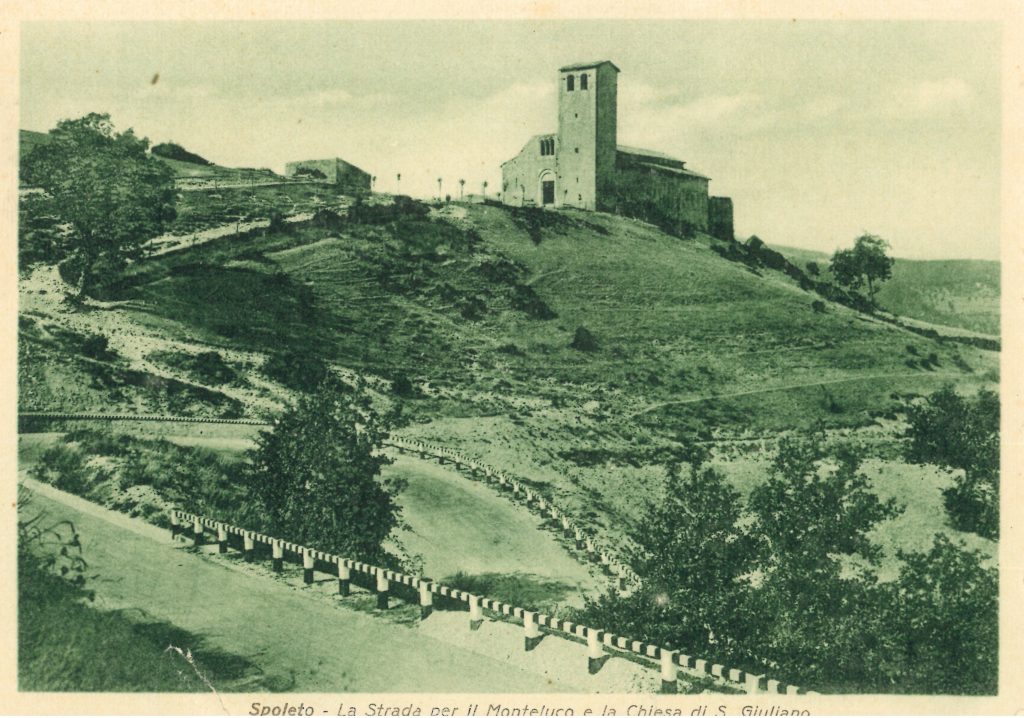
Reading the newspapers of the time kept at the Carducci library, it is possible to reconstruct the genesis, early stages and implementation of a project that intended to make Monteluco one of the cornerstones of the city’s tourist development, sacrificing, without too much hesitation, the ascetic aura of the place to make it an oasis of hospitality and well-being, but justifying it all for the future of the community.
The headline of Il Messaggero of 15 December 1916 was ‘Per l’avvenire di Spoleto’ (‘For the future of Spoleto’), describing the reasons that had led to the idea of a new road, winding up the slopes of the mountain, intended for cars, and setting few environmental qualms, in fact supporting a process that for some years had led to more and more small villas being built on the wooded slopes of Monteluco, and ancient hermitages being transformed into welcoming resorts, and even calling for the construction of new villas and the establishment of health and rest homes.

Approved by the city council in October of that year, the project – as is explicitly stated in the article, which contains excerpts from the report – was based on a few fixed points: to unite the small villas already built or under construction as easily as possible with the city; to pass close to San Giuliano, “this artistic glory of the region”; “to exploit the beauty of the mountain itself, which is almost impossible at present because of the enormous difficulty of access”. By taking advantage of the labour of prisoners of war, the costs could be considerably reduced, amounting to 72,000 lire, at the expense of the city and the private owners of the land, in ten years.
From the volume “Monte Luco” by Carlo Bandini, 1922, we offer excerpts from the preliminary project: The road starts from Ponte S. Pietro on the Tessino torrent at an altitude of about 366 m. and, following the downhill slope of the road known as Ponte delle Torri, it then develops along the slope of Monte di S. Giuliano, touching, by means of opportune turns, Monte Luco. At about 4 kilometres, it reaches a point of access close to the summit of S. Giuliano, at the height of 600 metres above sea level. From this point, with a suitable transversal, it reaches the magnificent slope of Monte Luco at 650 metres, from where it continues up to 787 metres, which is approximately the height of the Franciscan monastery. The purpose of this last stretch is to connect S. Giuliano and therefore also Spoleto with the upper slope of the Mount and the summit itself. It has a constant width of 5 m and a maximum slope of 6° with curves of a radius of no less than 20 m. Its overall length is about 7 kilometres.
To follow the progress of the work, we can look at the media of the time. On 21 January 1917, the weekly newspaper ‘Il Risveglio’ explained the reasons (practical, aesthetic and environmental) for favouring the side facing Spoleto for the development of the road, but complained about the obstacles and resistance that the financial and technical project, already approved, encountered from some private individuals who were slow to reach an economic agreement with the Municipality. In the following issue, “il Risveglio” is pleased to report that an agreement has finally been reached.

In March 1917, “Il Messaggero” announced that prisoners of war were expected from Cassino to start work on the hermitage of San Antonio. In an article in April 1917 it is said that the work had already begun a few days earlier. The following month, both “Il Messaggero” and “Il Risveglio” took part in an inspection, driving along the carriageway and describing in detail the project of the engineer Chiavarino, once again underlining how this was a precious opportunity for the development of Spoleto and emphatically praising the spectacle offered to the eye of those driving along it. But despite the fact that work is proceeding apace, the inauguration will take longer than expected.
“Two years later, on 29 October 1919, ‘Il Messaggero’ reported on a new inspection, attended by Mayor Ettore Santi, councillors, councillors and a representative of the press, to take one last ecstatic look at the ‘road about to be constructed, which can now be said to be built‘. Despite the criticism it has received, an epoch-making undertaking can now be contemplated in its entirety: “our historic Monteluco will certainly have a future, especially in the summer season, with this new, comfortable road“.
And yet, shortly after completion of works, the topic of accessibility on Monteluco came up again, proposing a daring idea: the construction of a cable car linking the mountain and the town, a project that was never realised, the story of which we have already told in one of the first issues of this column.
NEWS ARCHIVES
- Carla Fracci, Grand Dame of Italian Ballet | 4 June 2021
- The city’s electrical system comes into operation | 28 May 2021
- The Spoleto-Forca di Cerro 1926 Car Race | 21 May 2021
- Great Craftsmen from Spoleto | 14 May 2021
- King Umberto I comes to town | 7 May 2021
- Achille Sansi, historian | 30 April 2021
- The Italian Resistance Movement | 23 April 2021
- Alessandro Onofri’s “Biancofiore” premiered | 16 April 2021
- The library at Palazzo Mauri | 9 April 2021
- The history of Ponte Garibaldi | 2 April 2021
- Dante in the Lands of the Duchy | 26 March 2021
- The City’s Remembrance Day | 19 March 2021
- The inauguration of the Vallocchia Urban Aqueduct | 12 March 2021
- Annibale della Genga and Porta San Gregorio | 5 March 2021
- Lawrence Ferlinghetti at the Festival Of Two Worlds | 26 February 2021
- August 1904. From a congress in Spoleto, the Federazione Nazionale delle Pubbliche Assistenze is born | 19 February 2021
- The Spoleto Carnival in posters from the 19th and 20th centuries, and in photos from the 1930s | 12 February 2021
- The Vocational School of Arts and Crafts | 8 February 2021
- December 1897: the Teatro Caio Melisso hosts the “Cinematograph” | 29 January 2021
- July 1904: first public phone booth in Spoleto | 15 January 2021
- Roman relics in the gardens of Spoleto | 8 January 2021
- Olive oil exhibition in 1930 | 18 December 2020
- The Town Hall in 1913 | 4 December 2020
- 1865: The third leg of the works on the Traversa Interna begins | 27 November 2020
- The birth of the Cotton Mill | 20 November 2020
- Racewalkers at the Giro della Rocca prepare themselves for the London Olympic Games: June, 1948 | 13 November 2020
- Teatro Nuovo: 10-11 September 1864 | 6 November 2020
- Images, August 1948. Teatro Nuovo, Spoleto, second edition of the competition for young opera singers | 30 October 2020
- The 1948 Mille Miglia in Spoleto. That time when Tazio Nuvolari… | 16 October 2020
- Beniamino Gigli in Spoleto in September, 1932 and August,1939 | 9 October 2020
- The Casina dell’Ippocastano | 2 October 2020
- Catalogue of public posters as documents of city chronicles | 25 September 2020
- 27 May 1948. When Gino Bartali crossed the finish line in Spoleto | 18 September 2020
- The Festival Of Two Worlds’ Yearbooks from 1975 to 1979 | 11 September 2020
- The 1967 Festival Of Two Worlds’ Yearbook | 26 August 2020
- The Festival Of Two Worlds’ Yearbooks #2 | 21 August 2020
- The Festival Of Two Worlds’ Yearbooks | 19 August 2020
- 1947-48: Motorcycling in Spoleto | 14 August 2020
- When the Spoleto soccer team’s name was Virtus | 7 August 2020
- Ads and commercials in 1910 Spoleto | 24 July 2020
- The Spoleto City Museum | 17 July 2020
- Restoration works at the Teatro Caio Melisso | 10 July 2020
- Folk feasts’ posters in early XXth-century Spoleto | 3 July 2020
- “Urban VIII on his way to Rome”: or the odd story of the Spoletan Bernini | 26 June 2020
- The ex Spoleto-Norcia Railway: from the first project to its opening | 19 June 2020
- Spoleto Tourist Guidebooks #3 | 12 June 2020
- Christo’s Art at the Festival of Two Worlds | 5 June 2020
- Raffaele Canè – Pictures | 29 May 2020
- Spoleto Tourist Guidebooks #2 | 22 May 2020
- Spoleto Tourist Guidebooks | 15 May 2020
- Pietro Mascagni: the concert at the Teatro Nuovo | 8 May 2020
- The cable car Spoleto-Monteluco | 1 May 2020
- Two days of aviation in Spoleto | 24 April 2020


