

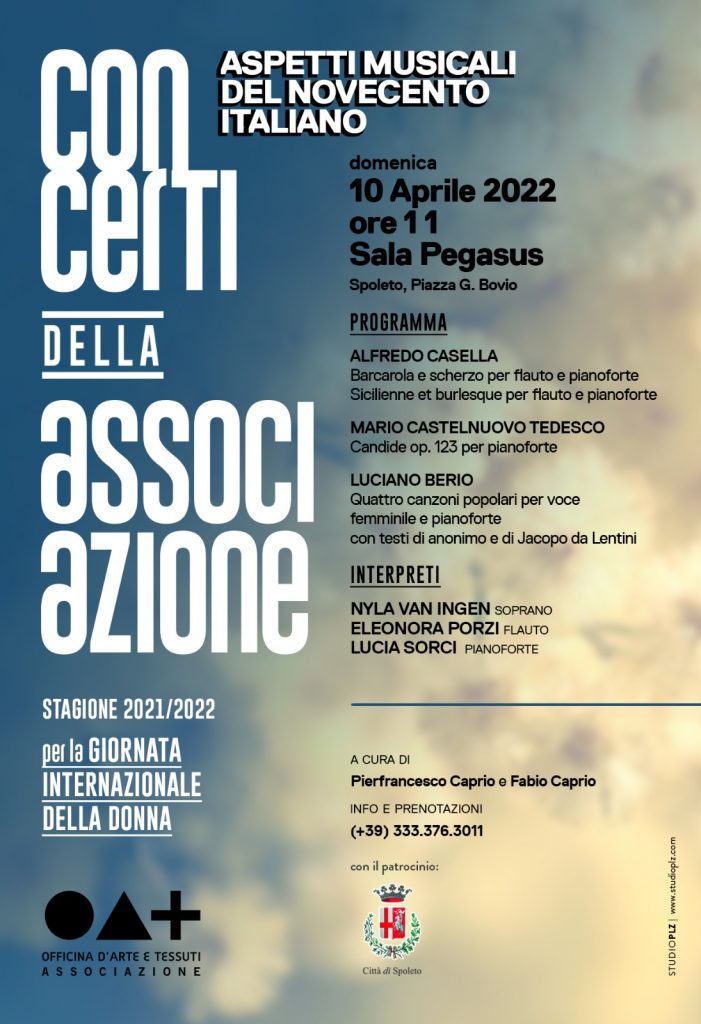
Sunday 10 April 2022, h 11.00 am | Sala Pegasus
CONCERT for the 2022 INTERNATIONAL WOMEN’S DAY
With this event, which is part of the City of Spoleto’s programme for International Women’s Day 2022, the Associazione Officina d’Arte e Tessuti begins a new series of concerts devoted to music from the XX and XXI centuries.
A contribution to the dissemination of the music of a period rich in new expressions, especially that of the second half of the twentieth century when there was, as Paolo Rotili writes, “a real explosion of trends, ideals, research, compositional techniques and musical writing”, particularly with the generation of musicians such as Luigi Nono, Luciano Berio, Sylvano Bussotti, Mauro Bortolotti, Salvatore Sciarrino and others.
The series, which will run until 2023, will also feature the generation born at the end of the XIX century. The concert on 10 April will feature three musicians who, despite their cultural diversity, have variously expressed a change in musical language: Luciano Berio, a protagonist of the second half of the 20th century; Alfredo Casella, born at the end of the 19th century and therefore active in the early 20th century; Castelnuovo Tedesco, who is present in the early 20th century with a personal musical vision, also due to his stay in the USA.
Organised by Associazione Officina d’Arte e Tessuti – Spoleto
Curated by Pierfrancesco Caprio e Fabio Caprio
Sala Pegasus, Piazza G. Bovio, 11.00 am
Free admission, donations are accepted.
Programme: Luciano Berio, Mario Castelnuovo Tedesco, Alfredo Casella
Interpreters: Nyla Van Ingen, Soprano//Eleonora Porzi, Flute//Lucia Sorci, Piano
Info and reservation: officinadartetessuti21@gmail.com | +39 333 3763011
LUCIANO BERIO (1925 – 2003)
In the second half of the 20th century, a new generation of composers such as Boulez, Lygeti and others proposed new goals and languages, as well as a different conception of music. The end of World War II brought about social, cultural and economic changes. Many artists overcame the trauma with rationality, technique and rigour. Others went their own way and rose up against the rigours of technicality, unconstrainedly exploring new areas. These include well-known musicians, such as Luigi Nono, Bruno Maderna and above all Luciano Berio, one of the greatest exponents of the second half of the 20th century. Berio’s importance lies in the fact that he considered music not as a restricted territory, far from life. His was an invitation to musicians, but also to all of us, to broaden our horizons, while never destroying the past. Together with Maderna he founded the famous Studio di fonologia in Milan.
MARIO CASTELNUOVO TEDESCO (1895 – 1968)
A musician more closely tied to the traditional canons of early 20th century music, Mario Castelnuovo Tedesco was born in Florence into a family of Sienese bankers of Jewish origin. After obtaining diplomas in composition and piano (from 1914 to 1918), he won a composition competition in 1925 with La Mandragola by Machiavelli. The opera was performed at the Teatro La Fenice in Venice but in 1939, due to the infamous racial laws, he was forced to leave Italy for the United States of America, where he was signed by Metro Goldwin Mayer to compose soundtracks for films (Doctor Jekyl and Mister Hyde, Ten Little Indians, etc.). He obtained American citizenship in 1946. In addition to film music, he composed numerous works including: Three Chorales on Hebrew Melodies, Suite in the Italian Style, Sonata for Guitar Omaggio a Boccherini, 24 Caprichos de Goya, Two Violin Concertos and Two Quintets for Guitar, Piano and Strings.
The concert’s programme also includes Voltaire’s Candide, a work for piano composed in 1944, first performed in 1949 in Los Angeles.
ALFREDO CASELLA (1883 – 1947)
He was a leading figure in music in Italy between the two World Wars. His project of Italian modern music was expressed through a document signed by the composer himself with Malipiero, Davico, Bastianelli and Ferranti and with the performance of the concert of Italian music held in Paris on 2 February 1914. This was the beginning of the so-called Generation of the 1880s (Alfano, Casella, Malipiero, Pizzetti and Respighi). They are credited with having revived the Italian instrumental tradition, which had been overshadowed by melodrama. But this return of instrumental music was marked by a nationalistic perspective, which reduced and in some cases nullified in Casella the reformist spirit of the time, making his contacts with the European avant-garde lacking. Despite the limitations of the context in which it was born, Casella’s music deserves to be re-proposed and listened to without prejudice. Among the composers of the Generation of the 1880s, Casella was certainly the most open to Europe, due to his own training, which had seen him study in Paris in Gabriel Fauré’s class, and to his professional contacts and friendship with all the greatest European composers.
The programme includes Casella’s Barcarola e scherzo for flute and piano (1903) and the famous Sicilienne et burlesque (1917) op. 23 bis. A work of the musician’s so-called third manner, already experimented with in the Eleven Children’s Pieces for piano and Tre Canzoni Trecentesche, Op. 36. It was a new aspect of the Maestro’s work between 1914 and 1920, later abandoned. In front of frequently dissonant ninth chords, a melody typical of the languid Italian nenia unfolds, softened by ornaments. La Sicilienne reaches one of the most interesting moments of the composer’s lyricism.


