

Today we will speak about a man who wanted to govern at all costs the Duchy of Spoleto so much to become duke for 3 times: Thrasimund II!
In the last few weeks we saw how the centralizing policy of King Liutprand had first imposed to Faroald II to return Classe to the Byzantines and then led to the uprising of his son Thrasimund II against his father, considered too condescending towards the king, so much so as to take his place and push him to retire to a convent.
Thrasimund II (720-742), embodying in an excellent way the traditional autonomist instances of the Dukes of Spoleto, was bent by King Liutprand several times and several times he rebelled against him, thanks to the support of the popes, for whom he had taken part in the iconoclastic controversy.
The interests that moved the Dukes of Spoleto and Benevento and the Pontiff against the king were the same: independence and power. It is unsure whether the three (Thrasimund II, Romuald II and Gregory II) had reached a formal agreement, but it is a fact that Liutprand, realizing their intentions, in 727 came into conflict with the papacy, and then, being a Catholic, came to terms with Rome the following year. In 729 he also resumed control over the rebel dukedoms of Spoleto and Benevento.
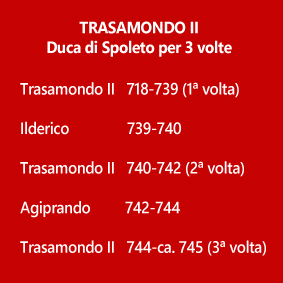
Thrasimund’s impatience with the king’s politics further undermined the relationship between the two, to the point of being accused by Liutprand of treason. On June 16, 739 the king besieged Spoleto and put Ilderic in charge. Thrasimund managed to escape and take refuge in Rome.
The king conquered Amelia, Orte, Bomarzo and Blera, yet pope Gregory refused to release the duke.
In 740 Thrasimund killed Ilderic and regained control over the duchy, thanks to help from Rome and Benevento.
Liutprand’s inevitable reaction would not wait long. It was 741 and Gregory II had been succeeded by Zechariah, a Greek who overturned alliances, and the Roman militia sided with Liutprand against Spoleto.
In 742, Liutprand’s army entered the Byzantine pentapolis and the duchy of Spoleto where, between Fano and Fossombrone, an important battle against Thrasimund took place.

On this occasion, Paul the Deacon tells us of two young brothers commanding the king’s rearguard with the Friulian contingents: Ratchis, Duke of Friuli, and Aistulf (both bound for wearing the crown years later) and Ratchis’ merciful courage towards an attacker from Spoleto (Paul the Deacon, HL VI, 56).
In Terni, the king met Pope Zechariah, to whom he returned the property forfeited a few years earlier and established a twenty-year peace. Rome undertook not to ally itself with Spoleto and Benevento, and not to put conditions on the king’s initiatives against the Byzantines and their dominions in Italy.
Agiprand, the king’s nephew, became Spoleto’s new duke.
But once again, Thrasimund did not give up, and at the death of Liutprand in 744, he took possession of the Duchy of Spoleto again. He died one year later.
NEWS ARCHIVES
- Abbey of San Pietro in Valle | 5 October 2020
- Faroald II, duke of Spoleto (681-728) | 28 September 2020
- Edictum Rotharis |21 September 2020
- I speak Langobardic | 14 September 2020
- Thrasimund I | 7 September 2020
- The Langobards first-hand | 31 August 2020
- Atto: IV duke of Spoleto | 24 August 2020
- Theodelapius: duke of Spoleto | 10 August 2020
- The duchies of Spoleto and Benevento | 3 August 2020
- Ariulf, Spoleto’s 2nd duke | 27 July 2020
- The United Nations Educational, Scientific and Cultural Organization (UNESCO) | 20 July 2020
- The Langobards’ corner at Palazzo Mauri | 13 July 2020
- The Mosaic at Palazzo Pianciani | 6 July 2020
- The Duchy of Spoleto: Palazzo Mauri | 29 June 2020
- Nine years past the inclusion into the World Heritage List (WHL) | 22 June 2020
- The two bishops | 15 June 2020
- The duchy of Spoleto and its first duke, Faroald I | 8 June 2020
- Totem animals in the Langobards’ Imagination | 1 June 2020
- A thrust or a cut? | 25 May 2020
- The Warrior | 18 May 2020
- What a beard did these Langobards have!| 11 May 2020
- Intelligence in their hands | 4 May 2020
- The aurifex and the techniques used in Goldsmithing at the times of the Langobards | 27 April 2020
- The aurifex and the importance of Goldsmithing in the Duchy of Spoleto | 20 April 2020


