

“From the very beginning, the Festival’s sketches were executed by set and costume designers known throughout the world, but also by sculptors (Moore, Franchina), painters (Guttuso, Campigli, Andy Warhol), authors and directors (Jean Cocteau, Luchino Visconti himself, Franco Zeffirelli)’: a theory of talents to make heads spin, as Gianna Volpi reminds us in her ‘Spoleto Story’.
Of these small works of art, these often unacknowledged masterpieces, we have chosen a few reproductions (contained in catalogues or theatre programmes) which we found among the material kept in the photo library of the “G. Carducci” Public Library and which are part of a collection currently being reorganised. The names are impressive: Andy Warhol, Gabriella Pescucci, Filippo Sanjust, Flaminia Petrucci, Diane Von Fürstenberg.
Before his all-out affirmation with the portraits of Marilyn Monroe and Campbell’s soup cans, not yet risen to the divine status of King of Pop Art and visionary creator of serial forms capable of indelibly engraving the collective imagination, Andy Warhol officially appears in the programme of the 1961 Festival among the curators of the sets and costumes of the sketch ‘Le die sorelle’ with Lucilla Morlacchi and Bice Valori.

“Le Due Sorelle” is a very short one-act play, written by Mario Felder (a pseudonym that Menotti himself allegedly hid behind), which was part of the short, minimal and experimental theatre pieces of “Fogli d’Album”, a varied container that presented the public with an “open” formula, sketches in prose and musical and choreographic interventions. Warhol was not new to the Spoleto Festival, having already collaborated with Menotti in 1959 when, for “Fogli d’Album”, as well as various uncredited interventions, he signed the cover of the score of A Hand of Bridge, an opera by Samuel Barber with a libretto by Menotti himself, which premiered in Spoleto in the second edition of the Festival.
Gabriella Pescucci, in the 1970s assistant to Pierluigi Pizzi and Piero Tosi, then a young costume designer who was making a name for herself in opera by repeatedly collaborating with Giuseppe Patroni Griffi, was to become one of the most awarded film costume designers in the history of the seventh art (one Oscar, two Emmy Awards, seven Silver Ribbons, two BAFTA Awards, two David di Donatello Awards).
It was under Griffi’s direction that Pescucci made her debut at the Spoleto Festival in 1972 with “Ascesa e rovina della città di Mahagonny”, a play by Weill based on a text by Brecht.

At the Spoleto Festival, together with Piero Tosi, she designed the costumes for Puccini’s “Manon Lescaut”, staged in 1973 and 1974 by Visconti, and then in 1975 for “Napoli: Chi Resta e Chi Parte”, a musical performance to scores by Raffaele Viviani created especially for the Spoleto Festival and which renewed the association between Patroni Griffi and Pescucci. The sketches created by Pescucci, reproductions of which are kept in the Photo Library, refer to the latter performance.

The untitled stage sketch made by the great costume and set designer Filippo Sanjust, who in 1979 was to be responsible in Spoleto not only for the sets and costumes of Monteverdi’s opera but also for its direction, probably refers to L’incoronazione di Poppea (Monteverdi’s musical drama set in ancient Rome). Also working for years alongside Visconti, Sanjust often linked his name to Spoleto and his clockwork precision would climax on the occasion of Donizetti’s Duca d’Alba directed by Visconti in 1959 for the Festival’s second edition, when he even used the original nineteenth-century sets to recreate, with philological rigour, the atmosphere and historical texture of the opera.
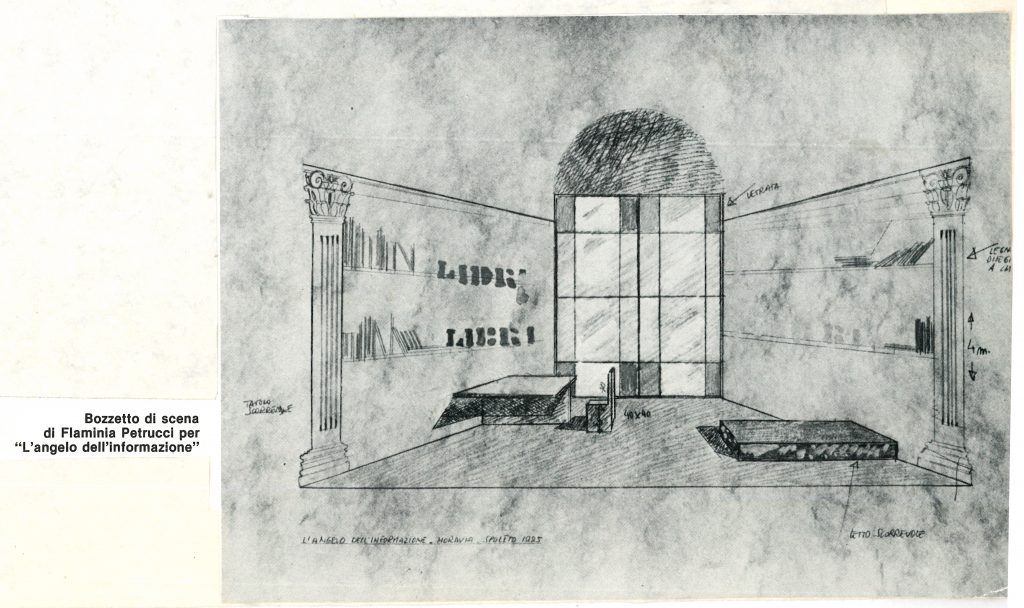
Flaminia Petrucci‘s stage sketches (as, plausibly, the costume sketches, entrusted to the famous stylist Diane Von Fürstenberg) belong to L’Angelo dell’informazione, a 1985 production directed and performed in Spoleto by Giorgio Albertazzi with Ombretta Colli and Walter Toschi, based on a play by Alberto Moravia, an acidulous portrait of a ménage à trois that is also an apologue on the pervasiveness of the mass media and information.

NEWS ARCHIVES
- Unesco Decade for the Basilica of San Salvatore | 25 June 2021
- 18 May 1979, the city tributes Thomas Schippers | 18 June 2021
- The Road to Monteluco | 11 June 2021
- Carla Fracci, Grand Dame of Italian Ballet | 4 June 2021
- The city’s electrical system comes into operation | 28 May 2021
- The Spoleto-Forca di Cerro 1926 Car Race | 21 May 2021
- Great Craftsmen from Spoleto | 14 May 2021
- King Umberto I comes to town | 7 May 2021
- Achille Sansi, historian | 30 April 2021
- The Italian Resistance Movement | 23 April 2021
- Alessandro Onofri’s “Biancofiore” premiered | 16 April 2021
- The library at Palazzo Mauri | 9 April 2021
- The history of Ponte Garibaldi | 2 April 2021
- Dante in the Lands of the Duchy | 26 March 2021
- The City’s Remembrance Day | 19 March 2021
- The inauguration of the Vallocchia Urban Aqueduct | 12 March 2021
- Annibale della Genga and Porta San Gregorio | 5 March 2021
- Lawrence Ferlinghetti at the Festival Of Two Worlds | 26 February 2021
- August 1904. From a congress in Spoleto, the Federazione Nazionale delle Pubbliche Assistenze is born | 19 February 2021
- The Spoleto Carnival in posters from the 19th and 20th centuries, and in photos from the 1930s | 12 February 2021
- The Vocational School of Arts and Crafts | 8 February 2021
- December 1897: the Teatro Caio Melisso hosts the “Cinematograph” | 29 January 2021
- July 1904: first public phone booth in Spoleto | 15 January 2021
- Roman relics in the gardens of Spoleto | 8 January 2021
- Olive oil exhibition in 1930 | 18 December 2020
- The Town Hall in 1913 | 4 December 2020
- 1865: The third leg of the works on the Traversa Interna begins | 27 November 2020
- The birth of the Cotton Mill | 20 November 2020
- Racewalkers at the Giro della Rocca prepare themselves for the London Olympic Games: June, 1948 | 13 November 2020
- Teatro Nuovo: 10-11 September 1864 | 6 November 2020
- Images, August 1948. Teatro Nuovo, Spoleto, second edition of the competition for young opera singers | 30 October 2020
- The 1948 Mille Miglia in Spoleto. That time when Tazio Nuvolari… | 16 October 2020
- Beniamino Gigli in Spoleto in September, 1932 and August,1939 | 9 October 2020
- The Casina dell’Ippocastano | 2 October 2020
- Catalogue of public posters as documents of city chronicles | 25 September 2020
- 27 May 1948. When Gino Bartali crossed the finish line in Spoleto | 18 September 2020
- The Festival Of Two Worlds’ Yearbooks from 1975 to 1979 | 11 September 2020
- The 1967 Festival Of Two Worlds’ Yearbook | 26 August 2020
- The Festival Of Two Worlds’ Yearbooks #2 | 21 August 2020
- The Festival Of Two Worlds’ Yearbooks | 19 August 2020
- 1947-48: Motorcycling in Spoleto | 14 August 2020
- When the Spoleto soccer team’s name was Virtus | 7 August 2020
- Ads and commercials in 1910 Spoleto | 24 July 2020
- The Spoleto City Museum | 17 July 2020
- Restoration works at the Teatro Caio Melisso | 10 July 2020
- Folk feasts’ posters in early XXth-century Spoleto | 3 July 2020
- “Urban VIII on his way to Rome”: or the odd story of the Spoletan Bernini | 26 June 2020
- The ex Spoleto-Norcia Railway: from the first project to its opening | 19 June 2020
- Spoleto Tourist Guidebooks #3 | 12 June 2020
- Christo’s Art at the Festival of Two Worlds | 5 June 2020
- Raffaele Canè – Pictures | 29 May 2020
- Spoleto Tourist Guidebooks #2 | 22 May 2020
- Spoleto Tourist Guidebooks | 15 May 2020
- Pietro Mascagni: the concert at the Teatro Nuovo | 8 May 2020
- The cable car Spoleto-Monteluco | 1 May 2020
- Two days of aviation in Spoleto | 24 April 2020


