

The IWD is celebrated today 8 March around the world; it would be interesting to discuss women’s role among the Langobards.

Among the Langobards, the female condition was still one of extreme submission to the male universe. Only the adult and free male, who was able to fight, enjoyed all civil and political rights. On the contrary, those who could not bear arms, such as women and minors, were obliged to submit to the protection of an adult man. Thus, a woman spent her entire life in the custody of a man who could be her father, brother or husband. This man possessed the mundio of the woman, i.e. the power to protect her. When the woman was given in marriage, the mundio automatically passed from the father (or brother) to the husband. Through the mundio, the man administered the woman’s possessions, represented her publicly, checked that her behaviour complied with the social and cultural rules of their people, and that she was not a source of dishonour to her family.

After the wedding night, once the marriage was consummated, the woman received the Morgengab, the morning gift. The bride came into possession of a quarter of her husband’s property. In case of sale of property, the man had to ask his wife’s permission. The husband did not have unlimited power over an honest woman, but he could get it in case of special situations, such as adultery, disinterest or the distance of the woman’s family.

In the Edict of Rothari, a girl who had been raped and who was pushed by her family towards a reparative marriage could place herself under the guardianship of the king. The sovereign took care of the girl and left her free to choose a new guardian or to remain under his protection. Whoever raped a woman was breaking the law. The rapist had to compensate the guardian of the raped woman. However, the king, being the great Mundwalt of all women in the kingdom, had a percentage of the fines for sexual abuse.
In reality, the condition of women was not so tragic. In Langobard dynasties, whether royal or ducal, women were the element of continuity par excellence: the queen or duchess was the one who transmitted royalty, and marriage to a royal widow ensured the title of legitimate sovereign. Some female figures, such as queens and abbesses, were given roles of political and social prominence with almost modern features.
The Langobards’ very origins are tied to a woman named Gambara, whom Paul the Deacon describes “sharp of wit and provident of advice”.
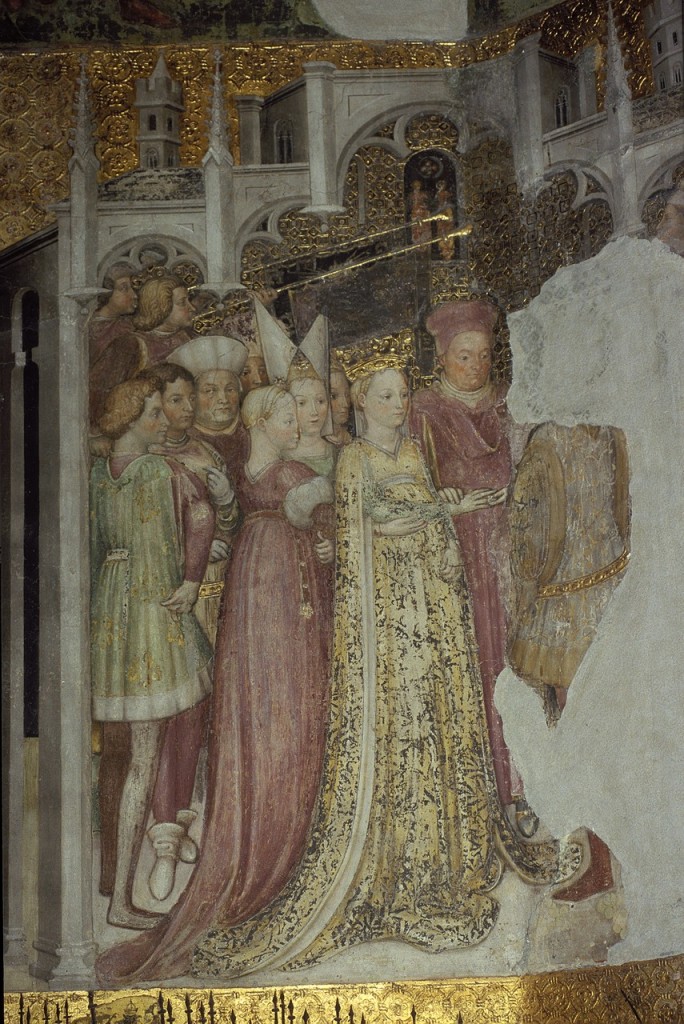
But the main female figure in the Historia Langobardorum is undoubtedly Theodelinde, a descendant of the ancient and noble Leti lineage.
In 584 Autari, who had become king by election of the assembly of dukes and warriors, married the princess Theodelinde, daughter of the duke of the Bavarians, in order to legitimise his power.
“King Autari sent his messengers to Bavaria to ask for the daughter of King Garibald to marry him. He welcomed them and promised them his daughter Theodelinde. As soon as Autari heard Garibald’s reply, he wanted to see his bride in person and immediately left for Bavaria, taking with him a few men and a trusted old man of rather authoritative appearance. When they were admitted into Garibald’s presence, Autari, whose true identity no one knew, approached Garibald and said: “My lord Autari has sent me here on purpose to see your daughter, his bride and our future queen, so that I can then describe to him exactly what she looks like. Garibald immediately sent for his daughter, and Autari stood looking at her in silence, for she was very pretty. Finally, satisfied with his choice, he said to the king: -Your daughter is very beautiful and deserves to be our queen. Now, if you have nothing against it, we would like to receive a cup of wine from her hands, as she must often do with us in future. – Garibald consented, and the princess, taking a cup of wine, first gave it to him who seemed the most authoritative, then offered it to Autari, without imagining even remotely that he was her husband: and Autari, after drinking, in returning the cup, furtively touched his hand with a finger and ran his right hand from his forehead along his nose and face. The princess blushed and reported this to her nurse, who replied: “If this were not the king who is to be your husband, he would certainly not have dared to touch you. But now let us pretend that nothing has happened; it is better that your father should know nothing about it. In my opinion, however, that man is a true king and an ideal husband. In fact, Autari was then in the prime of his youth, well-proportioned in stature, with blond hair and very handsome in appearance. […] Afterwards, as Garibald’s situation had become precarious following the invasion of the Franks, Theodelinde took refuge in Italy with her brother Gundoald and informed Autari of her arrival. He immediately went to meet her with great pomp to celebrate the wedding in the field of Sardi, near Verona, and married her on 15 May 589 to general rejoice”.
(Paul the Deacon, III, 30).
However, Autari died shortly afterwards. Given the urgency of the situation and the prestige she had earned at court, she was able to choose her new husband independently and the choice fell on Agilulf, Duke of Turin.
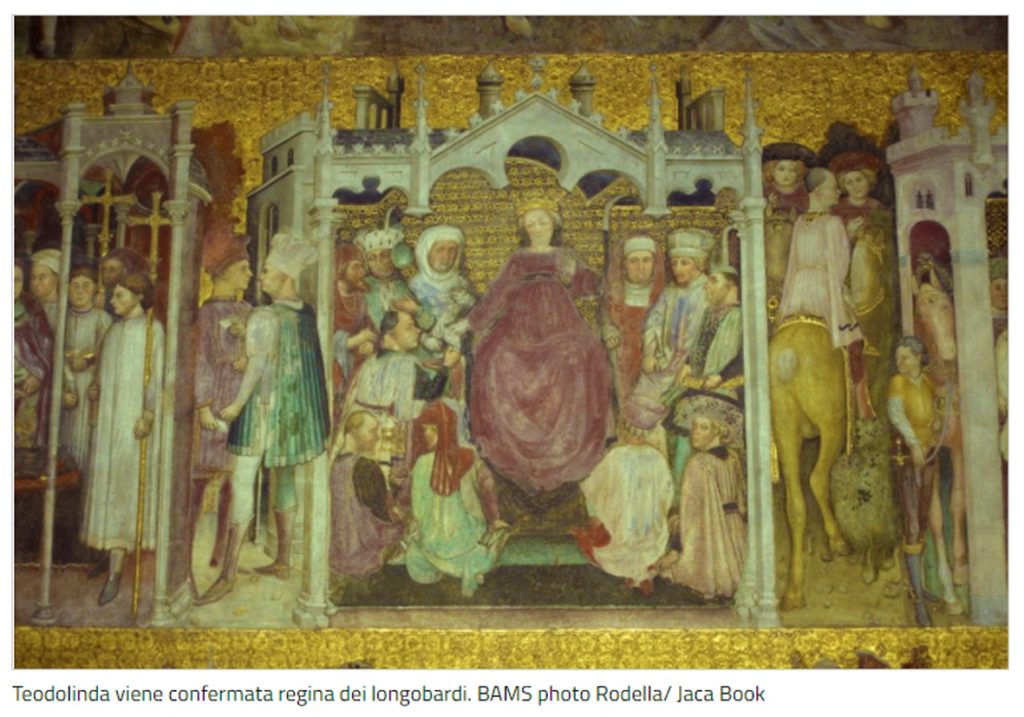
Queen Theodelinde began to approach the papacy, attracted by the extraordinary personality of Gregory the Great. Supported by her husband, she worked to encourage the Langobards’s conversion.
After Agilulf’s death in 616, Theodelinde would be regent for her son Adaloald until he came of age, but when he was deposed by a court conspiracy – after ten years of reign – she retired to private life.
A beautiful and intelligent woman, she was much loved by her people. She was a great patron of the arts and returned to the Church the goods taken away during the invasion and had new churches and monasteries built. In Monza, chosen as her summer residence, she built the Royal Palace, many religious buildings and a rich Basilica dedicated to St John the Baptist, where, on her death in 627, she was buried with all honours and venerated by the local people as a blessed.

Paul the Deacon describes the basilica as follows:
“The Langobards cannot be defeated by anyone because a queen, who came from another land, built the basilica of Blessed John the Baptist on Langobard soil and for this reason Blessed John continually intercedes for the Langobard people“.
Queen Theodelinde, after various moves, now rests in Monza Cathedral, in the chapel dedicated to her, surrounded by frescoes by the Zavattari.
Happy Monday with the Langobards!
NEWS ARCHIVES
- Theodicius, duke of Spoleto | 22 February 2021
- Dukes Alboin and Gisulf | 8 February 2021
- Liutprand, Ildebrand and Astulf | 25 January 2021
- Adoration of the Magi and Epiphany | 9 January 2021
- The attorta and the gubana of Cividale del Friuli | 22 December 2020
- Hackathon. Langobard digital marathon 1-4 December 2020 | 30 November 2020
- Games with the Langobards | 16 November 2020
- Duke Lupus | 2 November 2020
- Thrasimund II | 19 October 2020
- Abbey of San Pietro in Valle | 5 October 2020
- Faroald II, duke of Spoleto (681-728) | 28 September 2020
- Edictum Rotharis |21 September 2020
- I speak Langobardic | 14 September 2020
- Thrasimund I | 7 September 2020
- The Langobards first-hand | 31 August 2020
- Atto: IV duke of Spoleto | 24 August 2020
- Theodelapius: duke of Spoleto | 10 August 2020
- The duchies of Spoleto and Benevento | 3 August 2020
- Ariulf, Spoleto’s 2nd duke | 27 July 2020
- The United Nations Educational, Scientific and Cultural Organization (UNESCO) | 20 July 2020
- The Langobards’ corner at Palazzo Mauri | 13 July 2020
- The Mosaic at Palazzo Pianciani | 6 July 2020
- The Duchy of Spoleto: Palazzo Mauri | 29 June 2020
- Nine years past the inclusion into the World Heritage List (WHL) | 22 June 2020
- The two bishops | 15 June 2020
- The duchy of Spoleto and its first duke, Faroald I | 8 June 2020
- Totem animals in the Langobards’ Imagination | 1 June 2020
- A thrust or a cut? | 25 May 2020
- The Warrior | 18 May 2020
- What a beard did these Langobards have! | 11 May 2020
- Intelligence in their hands | 4 May 2020
- The aurifex and the techniques used in Goldsmithing at the times of the Langobards | 27 April 2020
- The aurifex and the importance of Goldsmithing in the Duchy of Spoleto | 20 April 2020


