

The ring road around Colle Sant’Elia, with its superb views of the upper town, the Albornoz Fortress and the Ponte delle Torri, is certainly one of the most popular promenades in town, appreciated by locals and tourists alike. Known as Giro della Rocca, it is a relatively recent urban development, completed only in the 1930s. Until 1817, when the Rocca Albornoziana was turned into a prison and extensive operations were undertaken in the area, there was nothing like today’s promenade underneath the fortress.
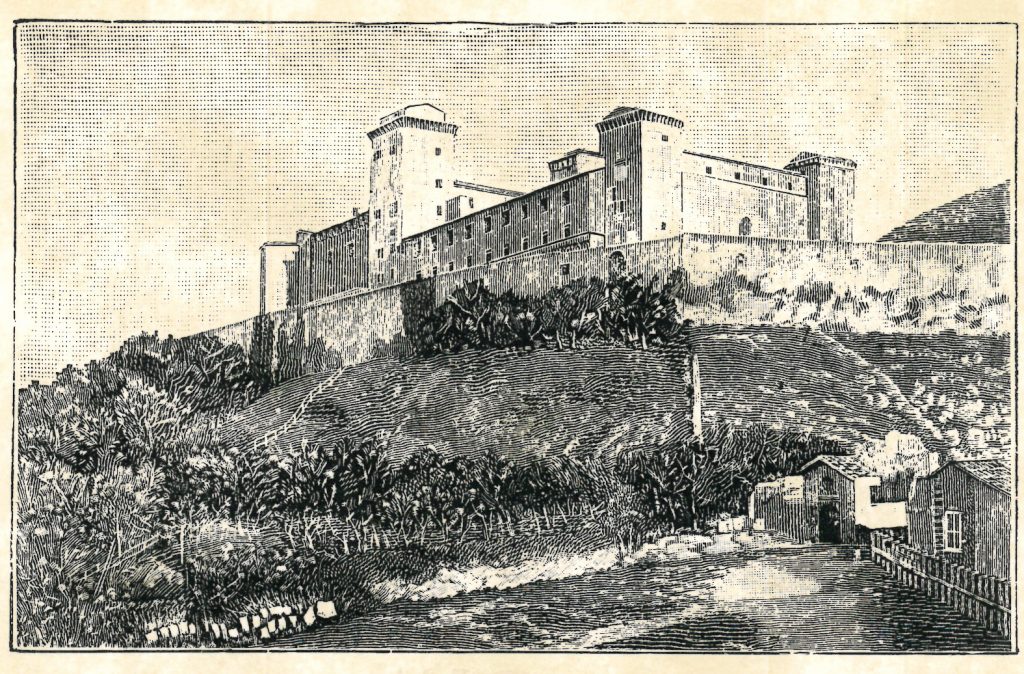
Until then, reaching the bridge from Piazza Campello was quite difficult, as the road was far from easy and not straight. One had to climb a section of the hill as far as the second gate of the Rocca. From there, one then proceeded along a small path until reaching the vicinity of the bridge. Looming over the town and protected by mighty walls that separated it from the town, the Rocca was an almost isolated element.
Carlo Bandini, in his 1933 volume on the Spoleto Fortress, quotes the politician and historian Paolo Campello as explaining the opening of the new road in more detail: “the opening of a road – the most pleasant, says Campello, and the most suitable to show the characteristic beauties of the city’s surroundings – the road that leads from Piazza Campello to the bridge, which until then “could not be accessed without climbing to the Fortress, and then descending again along an uncomfortable path”. Once the walls had been breached for the construction of a new gateway – the so-called Portella – the delightful road was promptly repaired’.
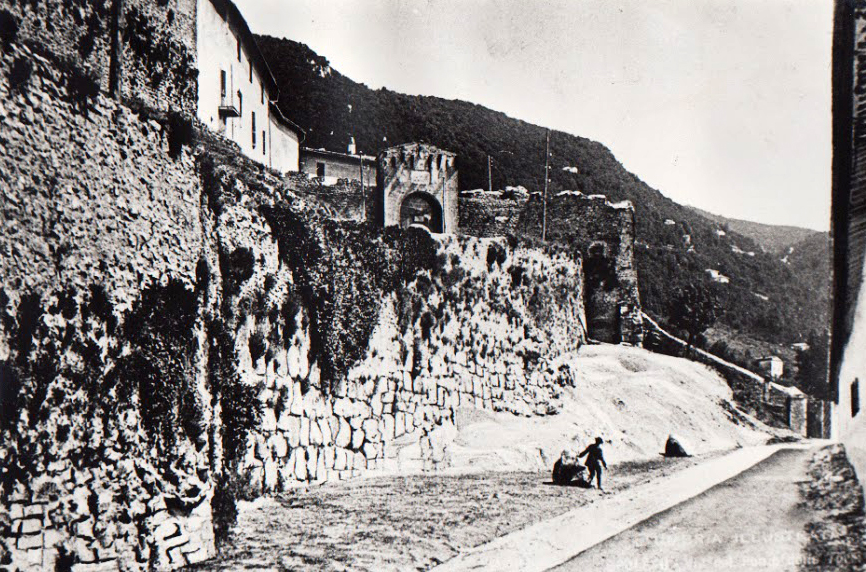
The construction of the new road, built on the appurtenances of the nearby convent of San Simone, was decided by Gonfalonier Bernardino Montani, who in that year of great building fervour was also responsible for the construction of the promenade (today’s Viale Matteotti), the new bridge over the Tessino outside Porta San Gregorio and the opening of the large arched window at the centre of the wall of Ponte delle Torri.
A few years later, in 1824 – Pietro Fontana being the city’s Gonfalone – the next stretch was laid out, that is the one from the Ponte delle Torri to the city, passing through the slopes of Monteluco: And again Carlo Bandini, in his 1924 guidebook to Spoleto, describes the “beautiful […] almost flat road” which from the Ponte delle Torri and on the Monteluco side, approaches the church of San Pietro, and then joins the Passeggiata, from where it crosses the public gardens and reaches Piazza Vittorio Emanuele [today Piazza Libertà]. This is the so-called “Giro del Ponte” – one of the easiest and most delightful of our walks”.
All this concerns the section from Piazza Campello to Ponte delle Torri via the Portella side, the only way to reach the bridge. But to complete the loop, an access from the opposite side remained to be built, in the area where the alternative mobility exits are now located. And many more years were to pass before it was finally completed.
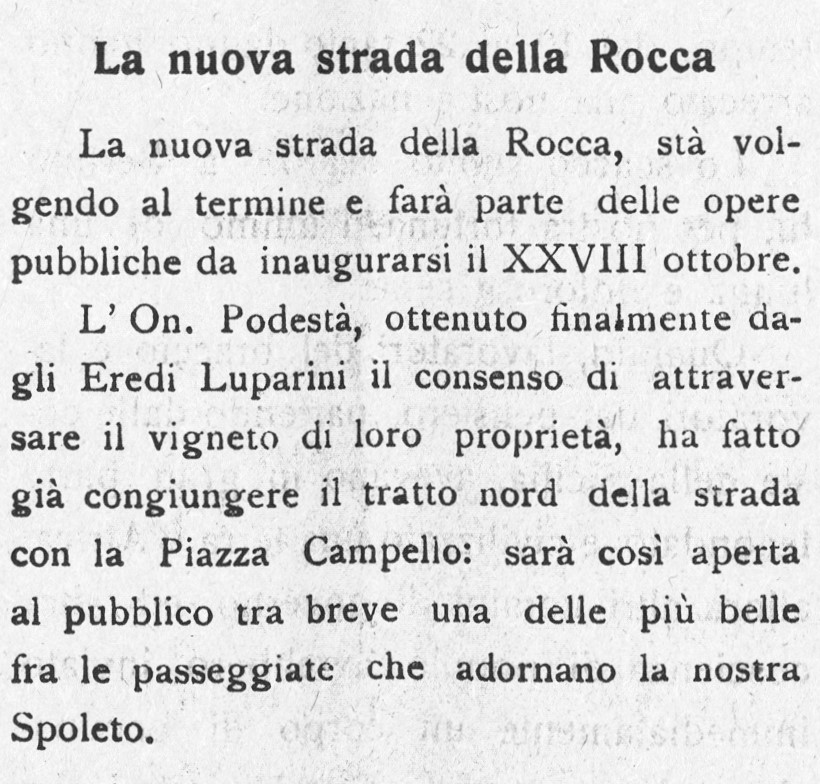
Work on the new section of the road, in the northern part of the area, was not completed until 1934. An article of 22 September in the weekly L’Alta Spoleto reminds us that the work was completed in a public ceremony on 28 October 1934 and thanks to an agreement with the Luparini family, who allowed their vast vineyards to be crossed and sacrificed.
NEWS ARCHIVES
- 1893, stage magic at the Teatro Nuovo | 8 October 2021
- Houses of Historical Spoletan Families | 1 October 2021
- April 1906. Inauguration of the plaque to Carducci | 31 August 2021
- 1891: Sordini digs out the Roman Theatre | 27 August 2021
- Piazza Campello before 1910 | 6 August 2021
- Il Ponte Sanguinario | 30 July 2021
- The new tunnel under the Rocca | 23 July 2021
- 1940, the dukes of Spoleto visit the new hospital | 16 July 2021
- Signature sketches at the Festival of Two Worlds (2) | 9 July 2021
- Signature sketches at the Festival of Two Worlds | 2 July 2021
- Unesco Decade for the Basilica of San Salvatore | 25 June 2021
- 18 May 1979, the city tributes Thomas Schippers | 18 June 2021
- The Road to Monteluco | 11 June 2021
- Carla Fracci, Grand Dame of Italian Ballet | 4 June 2021
- The city’s electrical system comes into operation | 28 May 2021
- The Spoleto-Forca di Cerro 1926 Car Race | 21 May 2021
- Great Craftsmen from Spoleto | 14 May 2021
- King Umberto I comes to town | 7 May 2021
- Achille Sansi, historian | 30 April 2021
- The Italian Resistance Movement | 23 April 2021
- Alessandro Onofri’s “Biancofiore” premiered | 16 April 2021
- The library at Palazzo Mauri | 9 April 2021
- The history of Ponte Garibaldi | 2 April 2021
- Dante in the Lands of the Duchy | 26 March 2021
- The City’s Remembrance Day | 19 March 2021
- The inauguration of the Vallocchia Urban Aqueduct | 12 March 2021
- Annibale della Genga and Porta San Gregorio | 5 March 2021
- Lawrence Ferlinghetti at the Festival Of Two Worlds | 26 February 2021
- August 1904. From a congress in Spoleto, the Federazione Nazionale delle Pubbliche Assistenze is born | 19 February 2021
- The Spoleto Carnival in posters from the 19th and 20th centuries, and in photos from the 1930s | 12 February 2021
- The Vocational School of Arts and Crafts | 8 February 2021
- December 1897: the Teatro Caio Melisso hosts the “Cinematograph” | 29 January 2021
- July 1904: first public phone booth in Spoleto | 15 January 2021
- Roman relics in the gardens of Spoleto | 8 January 2021
- Olive oil exhibition in 1930 | 18 December 2020
- The Town Hall in 1913 | 4 December 2020
- 1865: The third leg of the works on the Traversa Interna begins | 27 November 2020
- The birth of the Cotton Mill | 20 November 2020
- Racewalkers at the Giro della Rocca prepare themselves for the London Olympic Games: June, 1948 | 13 November 2020
- Teatro Nuovo: 10-11 September 1864 | 6 November 2020
- Images, August 1948. Teatro Nuovo, Spoleto, second edition of the competition for young opera singers | 30 October 2020
- The 1948 Mille Miglia in Spoleto. That time when Tazio Nuvolari… | 16 October 2020
- Beniamino Gigli in Spoleto in September, 1932 and August,1939 | 9 October 2020
- The Casina dell’Ippocastano | 2 October 2020
- Catalogue of public posters as documents of city chronicles | 25 September 2020
- 27 May 1948. When Gino Bartali crossed the finish line in Spoleto | 18 September 2020
- The Festival Of Two Worlds’ Yearbooks from 1975 to 1979 | 11 September 2020
- The 1967 Festival Of Two Worlds’ Yearbook | 26 August 2020
- The Festival Of Two Worlds’ Yearbooks #2 | 21 August 2020
- The Festival Of Two Worlds’ Yearbooks | 19 August 2020
- 1947-48: Motorcycling in Spoleto | 14 August 2020
- When the Spoleto soccer team’s name was Virtus | 7 August 2020
- Ads and commercials in 1910 Spoleto | 24 July 2020
- The Spoleto City Museum | 17 July 2020
- Restoration works at the Teatro Caio Melisso | 10 July 2020
- Folk feasts’ posters in early XXth-century Spoleto | 3 July 2020
- “Urban VIII on his way to Rome”: or the odd story of the Spoletan Bernini | 26 June 2020
- The ex Spoleto-Norcia Railway: from the first project to its opening | 19 June 2020
- Spoleto Tourist Guidebooks #3 | 12 June 2020
- Christo’s Art at the Festival of Two Worlds | 5 June 2020
- Raffaele Canè – Pictures | 29 May 2020
- Spoleto Tourist Guidebooks #2 | 22 May 2020
- Spoleto Tourist Guidebooks | 15 May 2020
- Pietro Mascagni: the concert at the Teatro Nuovo | 8 May 2020
- The cable car Spoleto-Monteluco | 1 May 2020
- Two days of aviation in Spoleto | 24 April 2020


