

While touring Italy, the exhibition “Trame longobarde. Tra architettura e tessuti” arrived at the Museo Sannitico in Campobasso where it was inaugurated on Saturday 29 May.

The exhibition-dossier realised by the City of Spoleto in 2013 and financed by Regione Umbria within the project “Musei che hanno stoffa”, with the curatorship of Glenda Giampaoli and Giorgio Flamini, scientific advisor Donatella Scortecci and the collaboration of the school IIS Sansi-Leonardi-Volta, has been enlarged and enriched during these 8 years thanks to the contributions of the Associazione Italia Langobardorum and the Ministry of Culture, L. 77/2006 “Siti UNESCO”.
A good practice for museum education, in its new guise it has been disseminated in almost the entire network of the serial site (Spoleto, Monte Sant’Angelo, Brescia, Benevento, Cividale del Friuli) but also in museums that are not part of it, such as the MANN in Naples and now the Museo Sannitico in Campobasso.

But what is the link with Molise? Probably not everyone knows that in Campochiaro, in the villages of Vincenne and Morrione, a necropolis with 400 tombs was discovered at the end of the 1970s. The grave goods discovered are on display at the Museo Sannitico in Campobasso. The knights of Campochiaro, buried together with their horses, were equipped with weapons, a belt, shoes and a jar placed at the feet of the deceased. “This territory was part of the Duchy of Benevento and particularly in Campochiaro a large necropolis was discovered with a Bulgarian population that fled Great Bulgaria (which is located between present-day Hungary and Moldavia) because of internal wars and took refuge in Lombardy,” explains archaeologist Davide Delfino. “The king of the Lombards was the Duke of Benevento and he sent them to the Duchy of Benevento where his son (who was in charge of the Duchy) enfeoffed them between Isernia and Sepino to have them as warriors who could defend the Duchy from Byzantine attacks. Generation after generation, these warriors were culturally lost because they mixed with the indigenous Lombard population, becoming Lombards in all respects.
The Polo Museale del Molise is a member of the Associazione Italia Langobardorum, the managing body of the Longobard UNESCO site.

Since its foundation in 2009, the association has always paid particular attention to young people by promoting and financing numerous initiatives, acting as a veritable laboratory of good practices, in which the know-how and experience of the staff of the UNESCO offices in the network become a wealth of shared knowledge.
Starting from a work that has intertwined scientific data and plausible reconstructions, the exhibition-dossier intends to propose an accurate interpretation of ancient weaving techniques through the reconstruction of fabrics, clothes and looms in use between the 6th and 8th centuries AD.
The reconstruction of textiles and clothing, in particular, is the thread that leads us to get to know the Longobard people more closely, starting with the objects and artefacts that were an integral part of daily life.
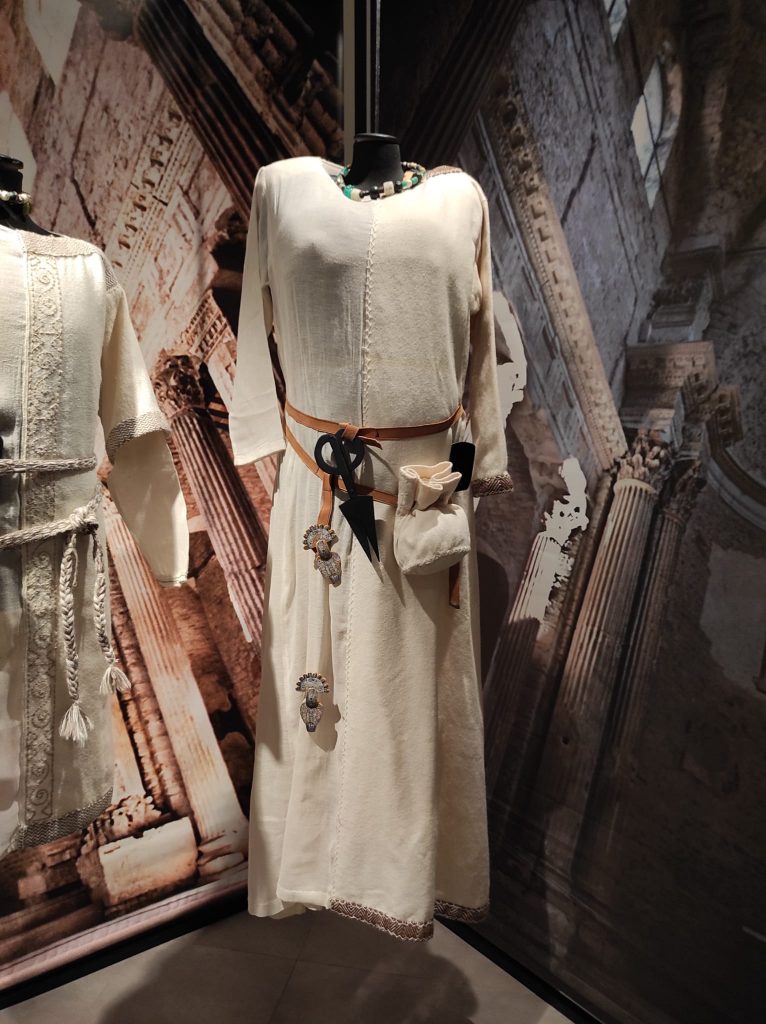
Half of the garments were woven by hand on horizontal heald looms, reproducing exactly the number of warp and weft threads per cm, as well as the thickness of the threads and the twists. Considering that these fabrics were probably made by women in the domestic sphere, the fabric heights were assumed to be quite small and compatible with the vertical looms, with weights or double looms, used in the reference period. The other half of the garments were made using an industrial cotton cloth to emphasise the fact that the model of the garment shown is the result of scientific contamination and the curators’ elaborations.
Precisely because of its educational value, the exhibition also includes a trunk, a self-supporting teaching room containing all the materials needed for the workshop. The didactic activities proposed with ‘Trame Longobarde’ – homogeneous throughout the network in terms of method and content – have been formulated with the aim of leading the user to discover the customs and traditions of the Langobards, interweaving not only threads, but also stories and knowledge. After a brief introduction on the history, culture and clothing of this people, experienced didactic operators – trained by the same experts of the technical-scientific group of the project – explain how to make a bracelet through the technique of weaving with tablet looms. At the end of the workshop, users will take the bracelet and the weaving kit with them.
At the inauguration, the president of the association Italia Langobardorum, Professor Rossella del Prete, cultural councillor of the Municipality of Benevento, explained the peculiarities of this exhibition-dossier.
After the stop in Molise, the exhibition will arrive in Valtopina to be set up inside the Museum of Embroidery and Textiles. The 19th edition of the Biennial Exhibition of Embroidery and Textiles, which will be held from 3 to 5 September 2021, has in fact indicated the theme “Embroidering Umbria” as “The thread of history: the Lombards in Italy and Umbria”. Participants are invited to interpret the signs of Lombard art with their own textile techniques: from jewellery to weapons, etc.
The exhibition-dossier will then continue its journey to be hosted in Campello sul Clitunno and, by the end of the year, in Castelseprio.
Happy Monday with the Langobards!
NEWS ARCHIVES
- The Colomba pasquale | 29 March 2021
- The role of women in the Langobard kingdom | 8 March 2021
- Theodicius, duke of Spoleto | 22 February 2021
- Dukes Alboin and Gisulf | 8 February 2021
- Liutprand, Ildebrand and Astulf | 25 January 2021
- Adoration of the Magi and Epiphany | 9 January 2021
- The attorta and the gubana of Cividale del Friuli | 22 December 2020
- Hackathon. Langobard digital marathon 1-4 December 2020 | 30 November 2020
- Games with the Langobards | 16 November 2020
- Duke Lupus | 2 November 2020
- Thrasimund II | 19 October 2020
- Abbey of San Pietro in Valle | 5 October 2020
- Faroald II, duke of Spoleto (681-728) | 28 September 2020
- Edictum Rotharis |21 September 2020
- I speak Langobardic | 14 September 2020
- Thrasimund I | 7 September 2020
- The Langobards first-hand | 31 August 2020
- Atto: IV duke of Spoleto | 24 August 2020
- Theodelapius: duke of Spoleto | 10 August 2020
- The duchies of Spoleto and Benevento | 3 August 2020
- Ariulf, Spoleto’s 2nd duke | 27 July 2020
- The United Nations Educational, Scientific and Cultural Organization (UNESCO) | 20 July 2020
- The Langobards’ corner at Palazzo Mauri | 13 July 2020
- The Mosaic at Palazzo Pianciani | 6 July 2020
- The Duchy of Spoleto: Palazzo Mauri | 29 June 2020
- Nine years past the inclusion into the World Heritage List (WHL) | 22 June 2020
- The two bishops | 15 June 2020
- The duchy of Spoleto and its first duke, Faroald I | 8 June 2020
- Totem animals in the Langobards’ Imagination | 1 June 2020
- A thrust or a cut? | 25 May 2020
- The Warrior | 18 May 2020
- What a beard did these Langobards have! | 11 May 2020
- Intelligence in their hands | 4 May 2020
- The aurifex and the techniques used in Goldsmithing at the times of the Langobards | 27 April 2020
- The aurifex and the importance of Goldsmithing in the Duchy of Spoleto | 20 April 2020


