

Can you recognise it?
It is one of the most important historical gates to the city, forming part of the medieval walls. Although well preserved, it underwent several restorations and renovations over the centuries that have somewhat altered its appearance.
This is the San Matteo gate – thus named because of its proximity to the ancient hospital housed in the monastery of the same name – also called the Loreto gate, because in the direction of the seventeenth-century sanctuary.
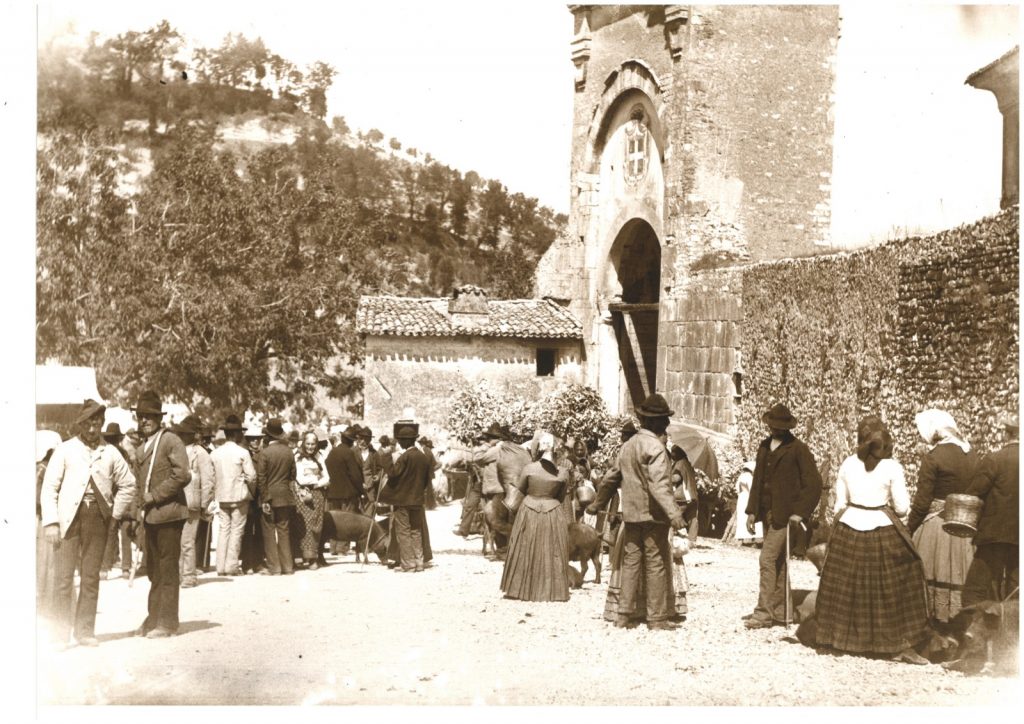
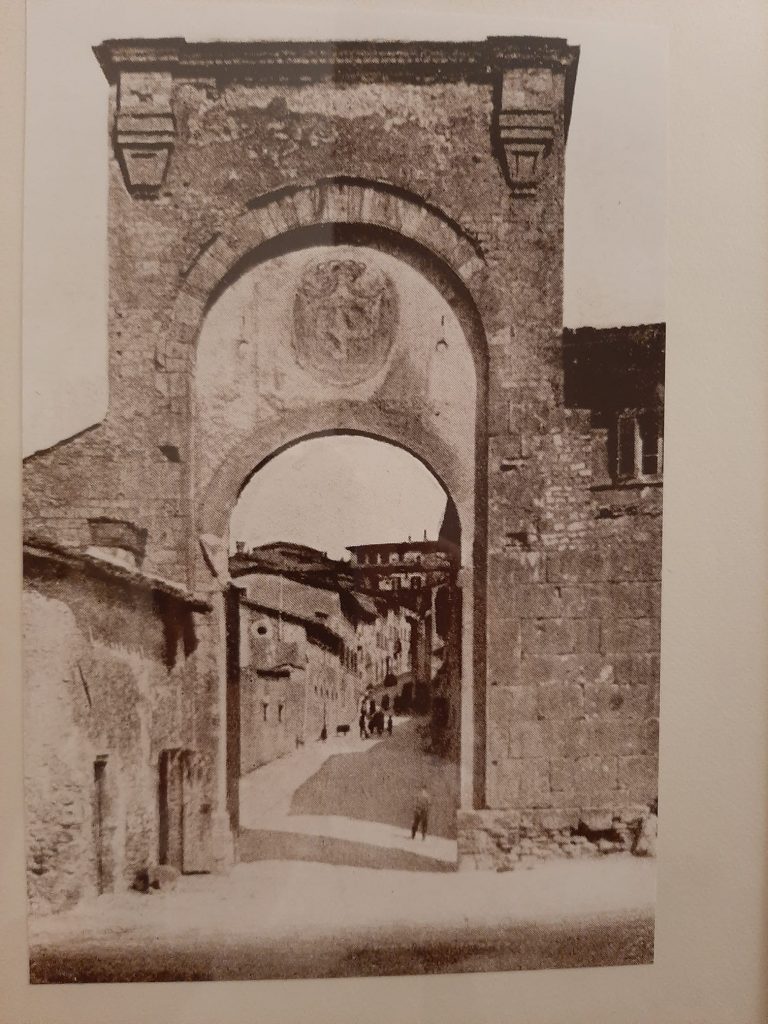
The photo kept in the photographic section of the Carducci library refers to somewhere in time between 1895 and 1915. On these two dates, the monument suffered major damage in two earthquakes. In 1895, a disastrous earthquake hit the upper part of the gate, which was restored, only to be hit again in 1915, when the hovel that served as a customs house, shown on the left of the photo, was also damaged. However, an inscription on the inside of the gate reminds us that it was already restored as early as 1673.
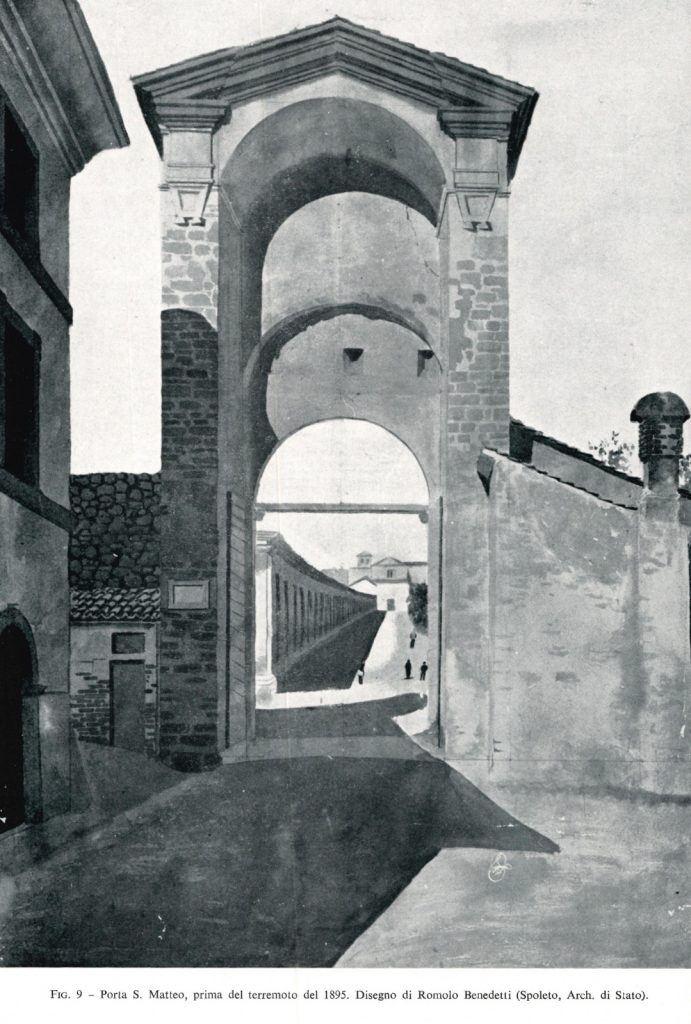
From issue 22 of “Spoletium” – in an article by Silvestro Nessi dedicated to the ancient and recent restoration of the city walls and gates – the interesting drawing we propose here shows the situation of the monument in the nineteenth century, before the damage.
Nessi’s article also contains some historical notes: the gate’s construction was decided in 1296 because of the city’s expansion, which led to the creation of wider ring-walls to include the new townships.
Before 1296, the following gates existed (although some of them had lost their role due to urban expansion): San Lorenzo (traces of which remain at the end of Via S. Agata and in a corner of Palazzo Mongalli), San Pietro (the present arch of Monterone), Postierla (just below Porta Fuga), Trinità (under the church of the same name in Via della Fonte Pescaia), Ponziana (then higher than the present gate). In the municipal statutes of 1296, it was decided to build three new monumental entrances to incorporate the new buildings that had sprung up downstream from the old gates: outside Porta San Pietro (the arch of Monterone) the current Porta Monterone was built, outside the old Porta Ponzianina the current Porta Ponzianina near the Tessino stream, and Porta San Matteo, the latter to include the already populous district that had sprung up outside Porta San Lorenzo, the city side known as ‘borgaccio’.
Porta San Matteo (St. Matthew’s Gate), one of the ancient city gates still existing, is composed of concealed stones and materials from ancient buildings. The old wooden doors are still visible.
Recently, in March 2021, restoration work on the wooden structure of the gate was completed by the Carispo Foundation.
News Archive
- Long Ago in Spoleto: the old southern access to town | 24 November 2021
- The Royal Experimental Oil Mill | 29 October 2021
- Alberto Talegalli | 22 October 2021
- When the Giro della Rocca did not exist yet | 15 October 2021
- 1893, stage magic at the Teatro Nuovo | 8 October 2021
- Houses of Historical Spoletan Families | 1 October 2021
- April 1906. Inauguration of the plaque to Carducci | 31 August 2021
- 1891: Sordini digs out the Roman Theatre | 27 August 2021
- Piazza Campello before 1910 | 6 August 2021
- Il Ponte Sanguinario | 30 July 2021
- The new tunnel under the Rocca | 23 July 2021
- 1940, the dukes of Spoleto visit the new hospital | 16 July 2021
- Signature sketches at the Festival of Two Worlds (2) | 9 July 2021
- Signature sketches at the Festival of Two Worlds | 2 July 2021
- Unesco Decade for the Basilica of San Salvatore | 25 June 2021
- 18 May 1979, the city tributes Thomas Schippers | 18 June 2021
- The Road to Monteluco | 11 June 2021
- Carla Fracci, Grand Dame of Italian Ballet | 4 June 2021
- The city’s electrical system comes into operation | 28 May 2021
- The Spoleto-Forca di Cerro 1926 Car Race | 21 May 2021
- Great Craftsmen from Spoleto | 14 May 2021
- King Umberto I comes to town | 7 May 2021
- Achille Sansi, historian | 30 April 2021
- The Italian Resistance Movement | 23 April 2021
- Alessandro Onofri’s “Biancofiore” premiered | 16 April 2021
- The library at Palazzo Mauri | 9 April 2021
- The history of Ponte Garibaldi | 2 April 2021
- Dante in the Lands of the Duchy | 26 March 2021
- The City’s Remembrance Day | 19 March 2021
- The inauguration of the Vallocchia Urban Aqueduct | 12 March 2021
- Annibale della Genga and Porta San Gregorio | 5 March 2021
- Lawrence Ferlinghetti at the Festival Of Two Worlds | 26 February 2021
- August 1904. From a congress in Spoleto, the Federazione Nazionale delle Pubbliche Assistenze is born | 19 February 2021
- The Spoleto Carnival in posters from the 19th and 20th centuries, and in photos from the 1930s | 12 February 2021
- The Vocational School of Arts and Crafts | 8 February 2021
- December 1897: the Teatro Caio Melisso hosts the “Cinematograph” | 29 January 2021
- July 1904: first public phone booth in Spoleto | 15 January 2021
- Roman relics in the gardens of Spoleto | 8 January 2021
- Olive oil exhibition in 1930 | 18 December 2020
- The Town Hall in 1913 | 4 December 2020
- 1865: The third leg of the works on the Traversa Interna begins | 27 November 2020
- The birth of the Cotton Mill | 20 November 2020
- Racewalkers at the Giro della Rocca prepare themselves for the London Olympic Games: June, 1948 | 13 November 2020
- Teatro Nuovo: 10-11 September 1864 | 6 November 2020
- Images, August 1948. Teatro Nuovo, Spoleto, second edition of the competition for young opera singers | 30 October 2020
- The 1948 Mille Miglia in Spoleto. That time when Tazio Nuvolari… | 16 October 2020
- Beniamino Gigli in Spoleto in September, 1932 and August,1939 | 9 October 2020
- The Casina dell’Ippocastano | 2 October 2020
- Catalogue of public posters as documents of city chronicles | 25 September 2020
- 27 May 1948. When Gino Bartali crossed the finish line in Spoleto | 18 September 2020
- The Festival Of Two Worlds’ Yearbooks from 1975 to 1979 | 11 September 2020
- The 1967 Festival Of Two Worlds’ Yearbook | 26 August 2020
- The Festival Of Two Worlds’ Yearbooks #2 | 21 August 2020
- The Festival Of Two Worlds’ Yearbooks | 19 August 2020
- 1947-48: Motorcycling in Spoleto | 14 August 2020
- When the Spoleto soccer team’s name was Virtus | 7 August 2020
- Ads and commercials in 1910 Spoleto | 24 July 2020
- The Spoleto City Museum | 17 July 2020
- Restoration works at the Teatro Caio Melisso | 10 July 2020
- Folk feasts’ posters in early XXth-century Spoleto | 3 July 2020
- “Urban VIII on his way to Rome”: or the odd story of the Spoletan Bernini | 26 June 2020
- The ex Spoleto-Norcia Railway: from the first project to its opening | 19 June 2020
- Spoleto Tourist Guidebooks #3 | 12 June 2020
- Christo’s Art at the Festival of Two Worlds | 5 June 2020
- Raffaele Canè – Pictures | 29 May 2020
- Spoleto Tourist Guidebooks #2 | 22 May 2020
- Spoleto Tourist Guidebooks | 15 May 2020
- Pietro Mascagni: the concert at the Teatro Nuovo | 8 May 2020
- The cable car Spoleto-Monteluco | 1 May 2020
- Two days of aviation in Spoleto | 24 April 2020


